
MusicTech.blog
Focusrite Scarlett 2i2 (4th Gen) Review
April 2, 2025
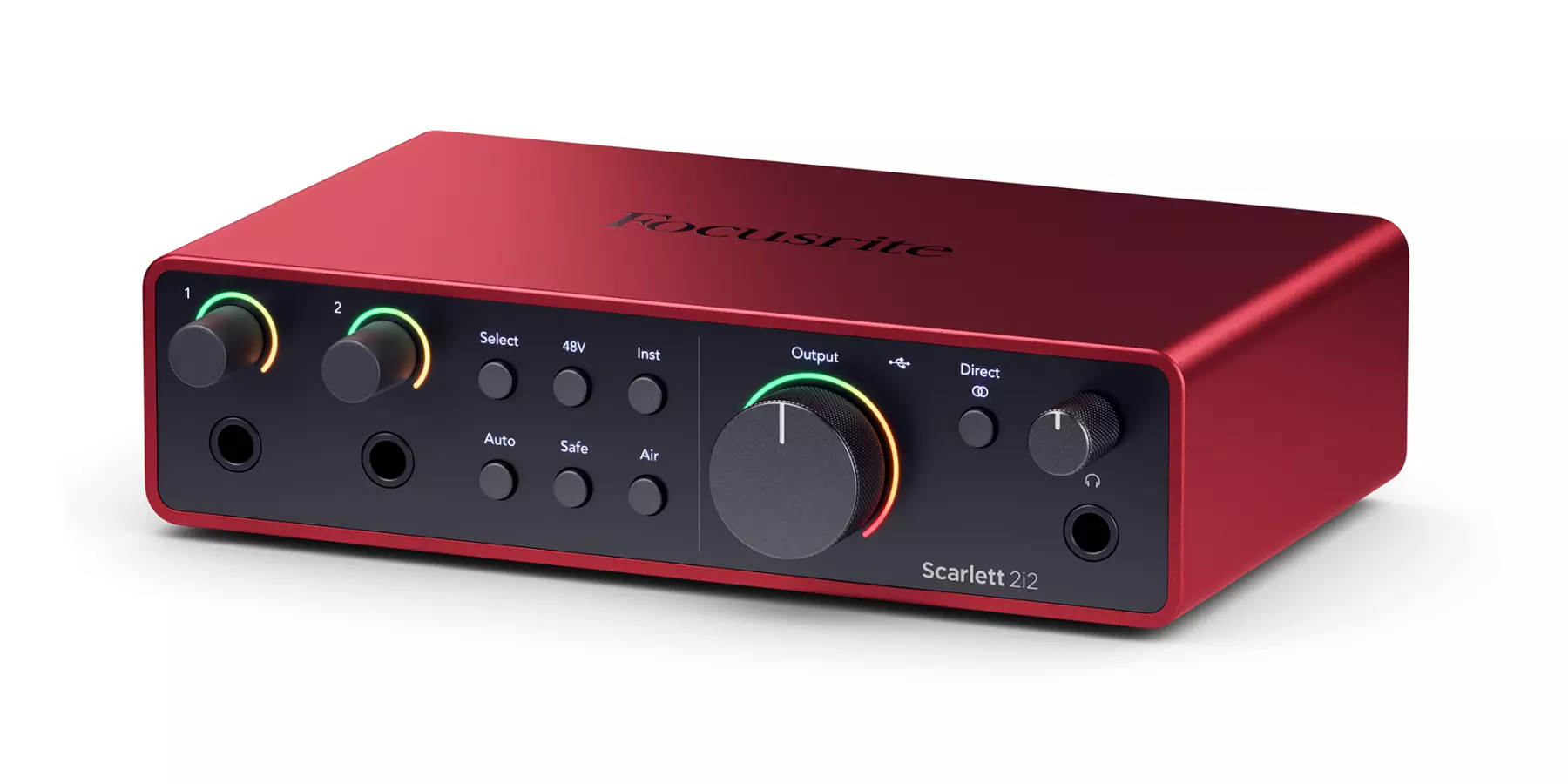
The Focusrite Scarlett 2i2 has been the default recommendation for home studio beginners for nearly a decade. The fourth generation — released in 2022 — updated the preamps, added Air mode, improved the headphone output, and introduced USB-C. The question worth asking is whether those updates justify the continued near-universal recommendation, or whether newer competition has changed the picture.
Short answer: the 2i2 (4th Gen) is still the right starting point for most home studio producers. Here’s the full picture.
Build and Design
The 2i2’s red aluminium housing is one of the most recognisable designs in music technology — compact enough to sit on a desk without taking over it, solid enough to handle regular travel and the occasional studio bump. The 4th generation maintains this form factor with minor refinements. At approximately 175mm × 47mm × 99mm and 340g, it’s genuinely portable — it fits in a laptop bag without thought.
Front panel: two combo XLR/TRS inputs (each with their own gain knob, 48V phantom power button, and Air mode button), instrument/line switching on input 2, a mono/stereo direct monitor switch, and a headphone output with its own level control. Rear panel: two balanced TRS outputs for studio monitors, a USB-C port, and a Kensington lock slot. The layout is logical and everything is where you’d expect it to be.
The Preamps
The 4th generation Scarlett 2i2’s preamps are the most significant upgrade over the previous generation. Focusrite spec them at 56dB of gain — enough for most microphones including dynamic microphones that require substantial gain, though high-gain dynamic microphones like the Shure SM7B or Electro-Voice RE20 will push them close to their limits on quiet sources.
In practice, the preamps are clean, low-noise, and transparent — they amplify the signal without adding significant colour of their own, which is appropriate for an interface intended to let the microphone’s character come through. Equivalent Input Noise (EIN) is rated at -129 dBu, which is excellent for this price tier and competitive with interfaces costing significantly more. Recording vocals, acoustic guitar, and quiet acoustic sources through the 2i2’s preamps produces results that are genuinely difficult to distinguish from preamplifiers costing two to three times as much.
Air Mode
Air mode is a high-frequency presence boost inspired by the transformer-based character of Focusrite’s ISA studio preamp range. Engaged, it adds a subtle lift in the upper frequencies — approximately 2–4 kHz and above — that adds openness, breath, and “air” to vocals and acoustic instruments. The character sits somewhere between a standard high-shelf EQ boost and the more complex high-frequency sheen of a transformer preamp.
Air mode is most useful on vocals and acoustic guitar. It’s a small but genuinely pleasant effect that adds polish to recordings without needing to reach for an EQ plugin. It’s less useful on electric guitar direct input or synthesizers where you want a more neutral capture. The key advantage over simply boosting the high shelf in your DAW is that Air mode’s character comes from the analogue circuit rather than a digital EQ, which tends to integrate more naturally — though the difference is subtle and many engineers would be hard-pressed to identify it in a blind test.
Converters and Audio Quality
The 2i2 supports recording and playback at up to 24-bit / 192kHz. Dynamic range is rated at 111dB for the inputs and 112dB for the outputs — both excellent figures for this price tier. In practice, you’ll work at 24-bit / 44.1kHz or 48kHz for nearly all music production work, and at these standard rates the 2i2’s converters are transparent and accurate.
The headphone output is a specific improvement in the 4th generation — louder and cleaner than the previous version, with enough output to drive most studio headphones to a reasonable listening level without strain. It still benefits from pairing with a dedicated headphone amplifier for high-impedance headphones (250Ω and above), but for 32–80Ω headphones it’s fully adequate.
Direct Monitoring
The 2i2 supports both mono and stereo direct monitoring, switchable via a front-panel toggle. In stereo mode, input 1 appears in the left channel and input 2 in the right — useful for recording stereo sources or for hearing a stereo playback mix accurately while tracking. The Mix knob blends between the direct input signal and the DAW playback. Direct monitoring eliminates monitoring latency entirely, which is the appropriate approach for tracking vocals and instruments where any delay is disruptive.
Driver and Software
On Windows, the Focusrite USB ASIO driver is stable, well-maintained, and achieves low latency at modest buffer sizes. At 128 samples, round-trip latency is typically 6–8 ms — low enough for comfortable real-time monitoring through the DAW. At 64 samples, latency drops below 5 ms on capable computers. The driver has a strong reputation for reliability across Windows 10 and 11.
On macOS, the 2i2 works via Core Audio with no driver installation required — plug in via USB-C and it’s immediately recognised. The Focusrite Control application (available on Windows and macOS) provides monitoring mix control and additional routing options.
Software Bundle
The 4th generation 2i2 includes: Pro Tools Artist (3-month subscription, then paid), Ableton Live Lite, Focusrite’s plugin collection (Focusrite Creative Pack including virtual instruments and effects), Antares Auto-Tune Lite, and access to a selection of third-party plugins via Focusrite’s software portal. For a first home studio, the bundle provides enough to start producing immediately without additional purchases — Ableton Live Lite in particular is a capable, fully functional DAW that’s not significantly limited for basic production and recording work.
What the 2i2 Doesn’t Do
The 2i2 tops out at two simultaneous inputs — one XLR mic and one instrument, or two XLR mics via the two combo jacks. If you need to record a drum kit with multiple microphones, track a full band simultaneously, or run a complex hardware setup with many inputs, the 2i2 is the wrong tool. The next step up within the Scarlett range is the Scarlett 4i4 (four inputs, MIDI I/O, balanced outputs) — appropriate for more complex setups.
The 2i2 also has no MIDI I/O — if you need to connect hardware synthesizers or drum machines via traditional five-pin DIN MIDI, you’ll need either a separate MIDI interface or a different audio interface that includes MIDI ports. For producers working entirely with USB MIDI controllers and virtual instruments, this is not a constraint.
How It Compares to the Competition
The SSL 2+ is the most direct competitor — two inputs, similar preamp quality, a similar price, and the addition of MIDI I/O that the 2i2 lacks. The SSL’s preamps have a slightly different character (some engineers describe them as slightly warmer) and the SSL Legacy Mode adds a subtle analogue-style harmonic saturation. For producers who want MIDI connectivity in their interface, the SSL 2+ is the better choice at this price tier.
The Audient EVO 4 is a strong value alternative with Audient’s well-regarded console preamp heritage in a compact two-input format. Its preamps are generally considered slightly warmer and more characterful than the Scarlett’s. For vocals and acoustic instruments, the EVO 4 is a genuine alternative worth auditioning.
The advantage the Scarlett 2i2 holds over both is ecosystem maturity: an enormous library of tutorials, troubleshooting resources, and DAW integration guides specifically for the Scarlett range. For first-time interface buyers, this support infrastructure has practical value that’s difficult to quantify but easy to appreciate when you’re setting up your first studio.
Verdict
The Focusrite Scarlett 2i2 (4th Gen) deserves its position as the most recommended home studio audio interface. The preamps are excellent at this price, the converters are clean, Air mode is a useful addition, the driver is stable, and the software bundle provides a genuine starting point for new producers. Its limitations — two inputs, no MIDI I/O, no DSP effects — are real but appropriate for its price point and target user.
If you’re starting a home studio and budget is a consideration, or if you’re buying an interface as part of a gift or recommendation for a new producer, the 2i2 remains the default right answer. If your needs are more specific — you need MIDI I/O, you want a different preamp character, or you already know you’ll need more than two inputs — the competition is worth examining. But for the majority of home studio producers at the beginning of their recording journey, the 2i2 is still the benchmark.