
MusicTech.blog
Wavetable Synthesis Explained: PPG Wave, Serum, and Morphing Sound
June 24, 2025
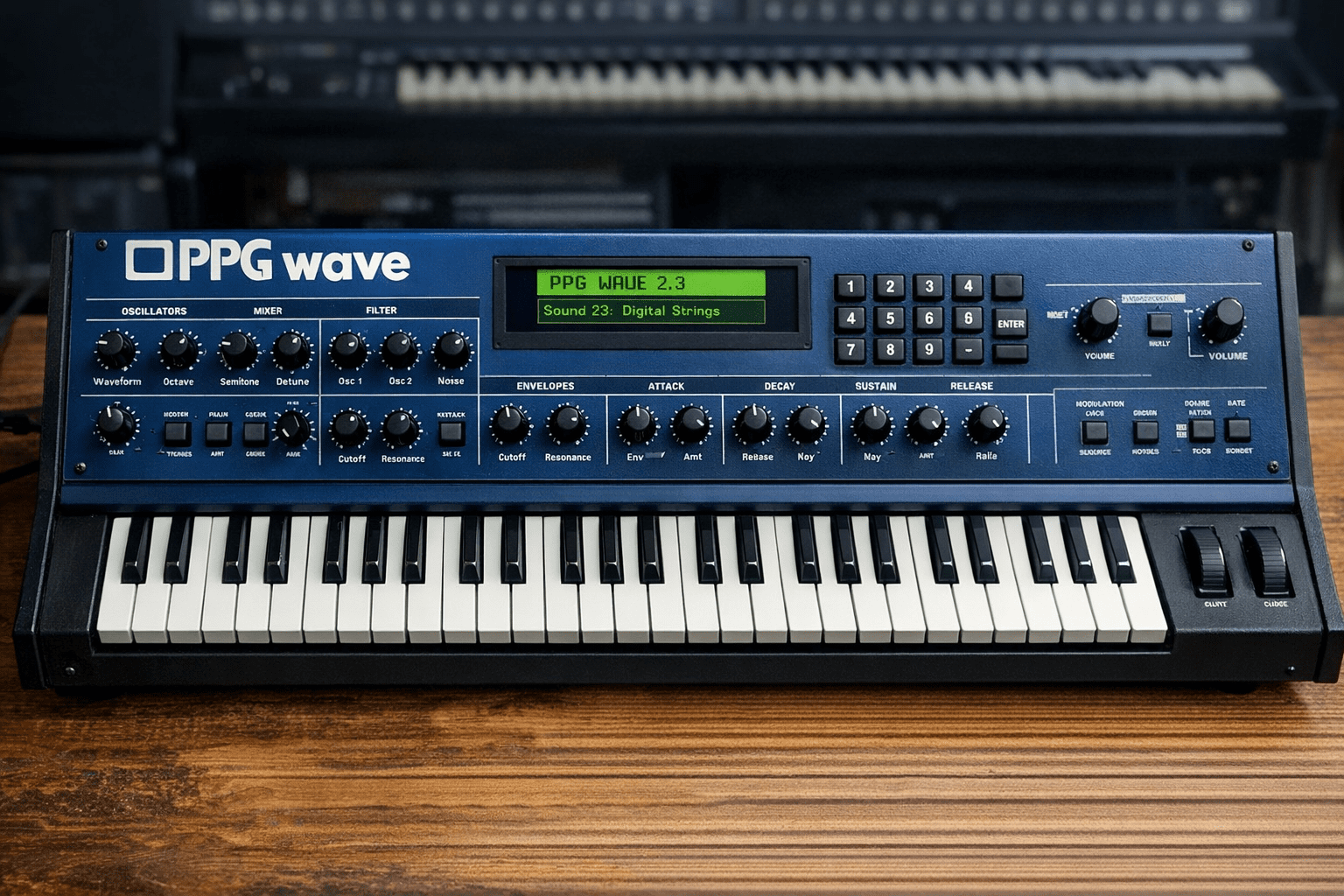
Wavetable synthesis is one of the defining synthesis methods of modern music production. It’s the technology behind instruments like the PPG Wave, the Waldorf Microwave, and today’s most popular software synthesizers including Serum, Vital (free), and Massive X. It produces a distinctly digital character: cold, bright, and harmonically complex in ways that analogue synthesis can’t replicate, but also capable of warmth and movement through skillful sound design. Understanding how it works opens up one of the most creatively productive synthesis methods available.
What Is a Wavetable?
A wavetable is an ordered collection of single-cycle waveforms. Each waveform in the table represents one complete cycle of an audio signal. If you looped just that one cycle continuously, you’d hear a pitched tone with the harmonic character of that waveform. A simple wavetable might contain a few dozen waveforms arranged in a sequence; a complex wavetable might contain hundreds, morphing gradually from one timbral character to another across its length.
The wavetable synthesizer reads through this collection of waveforms using a position parameter — the playback head moves through the wavetable, playing successive waveforms. At a fixed position, you hear a single waveform repeated, producing a static timbre. Moving the position — either manually or via modulation — morphs the sound from one timbral character to another as the oscillator reads successive waveforms. This continuous morphing is the sonic signature of wavetable synthesis: sounds that evolve and shift harmonically in ways that static oscillators cannot produce.
The PPG Wave: Where Wavetable Synthesis Began
The PPG Wave series — created by German engineer Wolfgang Palm and produced between 1981 and 1987 — is the origin of modern wavetable synthesis. The PPG Wave 2.2 and 2.3 combined digital wavetable oscillators with an analogue filter and effects section. The result was a sound that was simultaneously cold, crystalline, and harmonically rich in a way that purely analogue synthesis couldn’t achieve.
The PPG’s distinctive character — brittle, glassy, with a specific kind of digital sheen — became the defining sound of progressive rock and new wave productions in the early 1980s. Artists including Peter Gabriel, Kate Bush, Tangerine Dream, and Klaus Schulze used the PPG Wave extensively, and its sound is immediately recognisable in recordings from that era.
Wolfgang Palm went on to found Waldorf Music, which continued the wavetable tradition with the Microwave series, the Wave, and ultimately the Quantum. It’s a direct continuation of the PPG legacy into the present day.
Key Parameters in Wavetable Synthesis
Wavetable Position
Position determines which waveform in the wavetable is currently being played. This is the primary timbral control in wavetable synthesis — different positions in a wavetable have dramatically different harmonic content. Moving position gradually produces a smooth timbral morph; jumping position abruptly produces a discontinuous change in character. Assigning position to an LFO, envelope, or modulation wheel is the fundamental technique in wavetable sound design.
Wavetable Scanning
Scanning refers to moving through the wavetable over time — either at a fixed rate or driven by modulation. A slow LFO on the position parameter produces a gradual timbral evolution; a fast LFO produces a rapid, tremolo-like modulation of the harmonic content. An envelope on position produces a timbral attack-decay-sustain-release that mirrors the amplitude envelope but acts on the harmonic character rather than the volume. The sound is bright on the attack, settling to a simpler character in the sustain.
Morphing and Interpolation
When a wavetable synthesizer moves between waveforms in the table, it can either switch abruptly (which produces clicks and discontinuities at low positions) or interpolate smoothly between adjacent waveforms. Modern synthesizers like Serum and Vital use sophisticated interpolation that produces seamless morphs between waveforms at any position and rate. The smoothness of this morphing is one of the characteristics that distinguishes professional-quality wavetable synthesizers from simpler implementations.
Spectral Warping and Frame Manipulation
Modern wavetable synthesizers extend beyond simple position scanning with additional processing options applied to the wavetable in real time. Vital’s spectral warping applies FFT-based transformations to waveforms within the wavetable — stretching, bending, and reshaping the frequency content in ways that go beyond what the source wavetable contains. Serum’s wavetable editor allows complex waveform modification including phase manipulation, spectral addition, and harmonic control. These tools turn a wavetable from a fixed collection of waveforms into a dynamic, editable sound source.
Creating and Importing Custom Wavetables
A significant creative advantage of modern wavetable synthesizers is the ability to create or import custom wavetables — either designed from scratch or extracted from audio recordings.
Serum’s wavetable editor allows you to import any audio file and convert it to a wavetable by slicing the audio into single-cycle segments and arranging them in sequence. A vocal phrase becomes a wavetable. A drum loop becomes a rhythmic wavetable whose position parameter cycles through the attack and decay of each hit. A recording of a room resonance becomes a unique timbral fingerprint. This ability to turn any audio into a playable wavetable is one of the most distinctive creative features of the format.
Free wavetable collections are widely available online. The community around Serum in particular has produced thousands of free wavetables covering classic synth waveforms, vocal formants, acoustic instrument extractions, and entirely novel timbres.
Key Wavetable Synthesizers
Xfer Serum
Serum is the dominant wavetable synthesizer in modern music production — particularly electronic dance music, future bass, pop, and any genre where evolving, high-definition digital synthesis is central to the sound. Its interface is clear and visually informative, its wavetable editor is comprehensive, its effects chain is professional quality, and its modulation system (drag any modulation source to any parameter) is fast and intuitive. The community around Serum — presets, wavetables, tutorials — is enormous. Serum is available on subscription or perpetual license.
Vital (Free)
Vital is a free wavetable synthesizer from Matt Tytel that competes directly with Serum in capability and surpasses it in some areas. Its spectral warping transforms provide unique wavetable manipulation options. Its visual modulation display (showing modulation depth on every parameter in real time) is one of the best in any synthesizer. The free tier is fully functional with three wavetable slots; paid tiers add additional wavetables and content. For producers who want professional wavetable synthesis without the cost of Serum, Vital is an outstanding alternative.
Native Instruments Massive X
Massive X is Native Instruments’ flagship wavetable synthesizer — a comprehensive redesign of the original Massive that defined a generation of EDM production. It features two wavetable oscillators with extensive shaping options, a sophisticated routing system, and a modulation architecture that rewards deep sound design. Massive X has a steeper learning curve than Serum but offers distinctive sound possibilities, particularly for complex, evolving textures and dense polyphonic pads.
Waldorf Quantum and Iridium
The Waldorf Quantum and its more compact sibling the Iridium represent the continuation of the PPG/Microwave wavetable tradition in hardware form. They combine wavetable oscillators with additional synthesis modes (granular, resonator, particle) and Waldorf’s characterful filter designs in a professional-grade hardware instrument. For producers who want the PPG Wave lineage in a modern, playable format, the Waldorf instruments are the direct continuation of that heritage.
Wavetable Synthesis in Practice
The most characteristic wavetable sounds are built around movement — slowly evolving pads, filter sweeps driven by wavetable position, and leads that shift harmonically over their sustain. The technique that defines wavetable synthesis in modern production:
- Modulate position with a slow LFO for continuously evolving pads that shift harmonic character without repeating
- Use an envelope on position for a timbral attack (bright entry, settling to simpler sustain) that adds punch and expressiveness
- Stack multiple wavetable oscillators with slight detuning and different position settings for a wide, harmonically complex unison sound
- Use wavetable position as an expressive control mapped to the modulation wheel or aftertouch for real-time timbral performance
- Combine with a classic analogue-style filter — wavetable oscillators into a resonant low-pass filter produces the warm/cold hybrid character that makes Serum and Vital so versatile across genres
Wavetable synthesis is one of the most versatile and accessible synthesis methods available today. The free availability of Vital, combined with the enormous community resources around Serum, means there has never been a better time to explore wavetable sound design. The sounds it produces are central to the character of contemporary electronic and popular music.