
MusicTech.blog
Additive Synthesis Explained: Building Sounds from Harmonics
May 28, 2025
Additive synthesis is the most direct implementation of acoustic physics in electronic music — the idea that any sound can be constructed by combining enough sine waves at the right frequencies, amplitudes, and phases. Where subtractive synthesis starts with a harmonically rich waveform and removes content, and FM synthesis creates harmonic complexity through modulation, additive synthesis builds sounds from the ground up, one partial at a time. It’s the most transparent synthesis method and also, in its full implementation, the most computationally demanding.
The Mathematical Foundation: Fourier’s Theorem
In the 19th century, mathematician Jean-Baptiste Joseph Fourier proved that any periodic waveform — no matter how complex — can be expressed as a sum of sinusoidal waves at different frequencies, amplitudes, and phases. This is the Fourier theorem, and it’s the mathematical basis for additive synthesis. A sawtooth wave, a violin note, a vowel sound, a bell — all can be decomposed into their constituent sine waves, and all can theoretically be reconstructed by adding those same sine waves back together.
The sine waves that make up a complex periodic waveform are called partials (or harmonics, when they fall on integer multiples of the fundamental frequency). The lowest frequency component is the fundamental, which defines the perceived pitch. Higher-frequency components are the overtones, which define the timbre — the characteristic quality that makes a piano sound like a piano and a violin sound like a violin even when playing the same note.
How Additive Synthesis Works
An additive synthesizer provides a bank of individual sine wave oscillators — each one representing a single partial. Each partial has independently controllable frequency, amplitude, and typically an independent amplitude envelope (so each partial can attack, sustain, and decay at its own rate). By setting the frequency ratios and amplitude relationships of the partials, and by animating their amplitudes over time with individual envelopes, you construct a sound from its acoustic building blocks.
A basic additive synthesizer might provide 16 or 32 partials. A sophisticated one — like the Kawai K5000 or software implementations — might provide 64 or 128. The more partials available with independent amplitude envelope control, the more accurately a real-world sound can be reproduced and the greater the flexibility in creating new timbres from scratch.
The key distinction from subtractive synthesis is that there is no filter stage. In subtractive synthesis, timbral evolution over time is primarily produced by the filter envelope — opening and closing the filter sweeps the harmonic content from dark to bright. In additive synthesis, timbral evolution is produced by the independent envelopes of each partial — some partials decay faster than others, some attack more slowly, and the changing balance between them over time produces the evolving timbre. This requires many more envelope parameters, which is one reason additive synthesis programming is more complex than subtractive.
Harmonic vs Inharmonic Partials
When the partials of an additive synthesizer are set to integer multiples of the fundamental frequency (1×, 2×, 3×, 4×, and so on), they’re called harmonic partials and the resulting sound has a clear, defined pitch. This is the configuration used to produce organ tones, sawtooth-like sounds, and voiced instrument tones.
When partials are set to non-integer frequency ratios — frequencies that don’t fall on the harmonic series — they’re called inharmonic partials and the resulting sound has an ambiguous or absent fundamental. Bells, gongs, marimbas, and metallophones have significant inharmonic content in their spectra, which is why they sound pitched but not in the same clear way that a violin or piano does. Additive synthesis can reproduce this inharmonic behaviour by setting partial frequencies to the non-integer ratios found in physical modelling analysis of these instruments.
The Hammond Organ: Additive Synthesis in Hardware
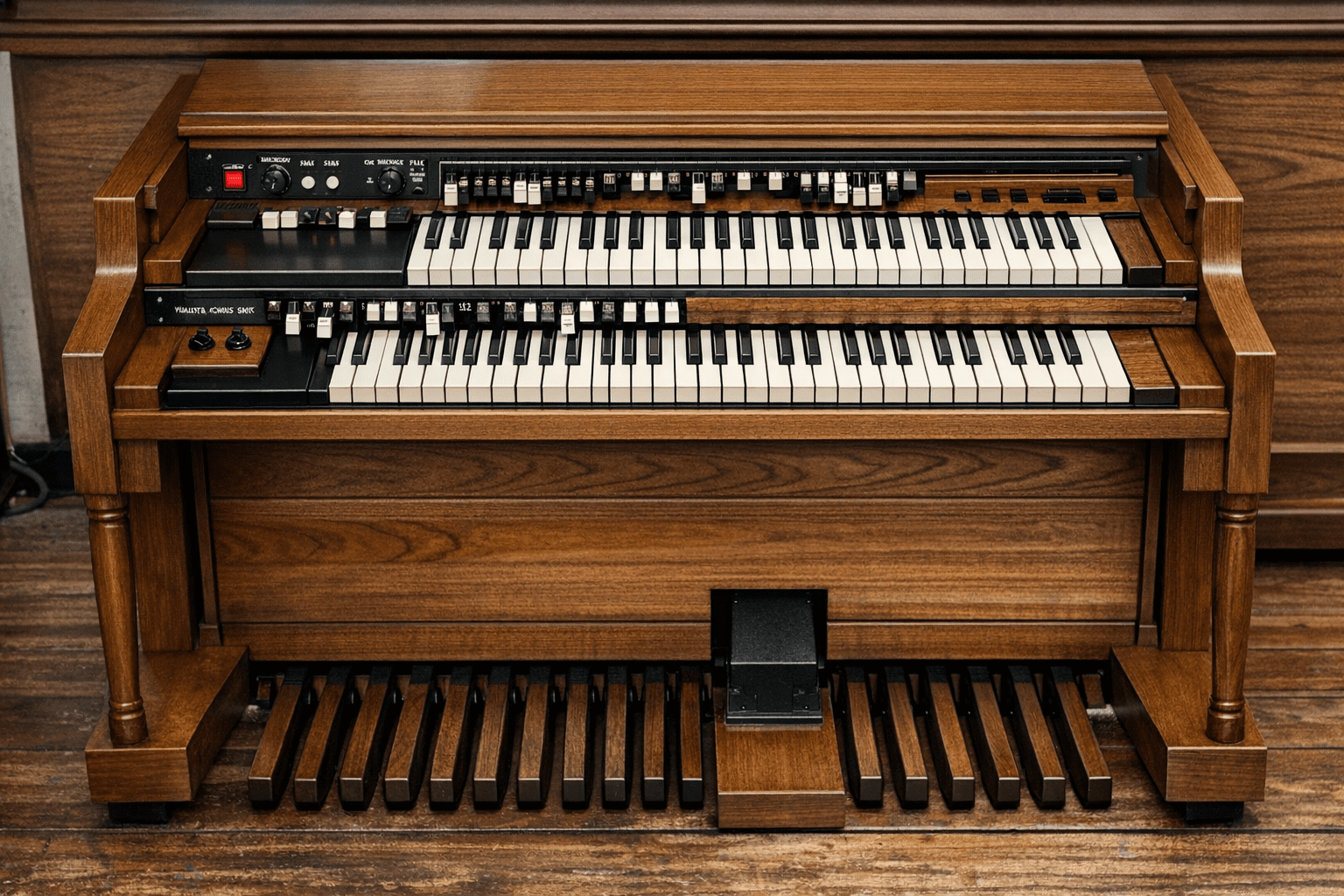
The most commercially successful and enduring implementation of additive synthesis principles is the Hammond organ, introduced in 1935. The Hammond uses a set of rotating tone wheels to generate sine-wave-like signals at harmonic frequencies. The nine drawbars on a Hammond organ correspond to nine different harmonics — the fundamental (8′), the octave (4′), the fifth above the octave (2⅔’), the second octave (2′), and additional harmonics above. Pulling a drawbar increases the amplitude of that harmonic component in the output.
The Hammond organ is additive synthesis made physical and mechanical — the drawbar positions are the amplitude settings for each harmonic partial, and the combination of drawbar settings defines the timbre. Jazz, gospel, rock, and classical organists have explored the expressive range of this system for nearly a century, and the Hammond’s characteristic tone remains one of the most distinctive and sought-after sounds in music.
Software Hammond emulations — Native Instruments B4, IK Multimedia Hammond B-3X, GSi VB3 — model this additive architecture directly, providing digital drawbar controls that correspond to the original’s harmonic structure.
Resynthesis: Analysing and Recreating Real Sounds
One of the most powerful applications of additive synthesis is resynthesis — using Fourier analysis to decompose a recorded sound into its component partials, then reconstructing it with an additive synthesizer. If the analysis is sufficiently detailed (enough partials, accurate frequency and amplitude tracking over time), the resynthesis can be indistinguishable from the original. More importantly, it can be modified: partials can be individually muted, tuned, amplitude-adjusted, or time-stretched independently of each other — manipulations that are impossible in the original digital audio domain.
The Yamaha Vocaloid system uses resynthesis-based techniques to model the human voice from phonetic analysis. IRCAM’s SuperVP and various spectral analysis tools use similar approaches for audio transformation in academic and electroacoustic composition. In the commercial plugin world, iZotope’s RX and Melodyne use partial-based analysis for pitch correction and spectral repair — both are applications of additive principles even if not labelled as additive synthesis.
Additive Synthesis Instruments
Kawai K5000
The Kawai K5000 (1996) is the most fully-realised commercial additive synthesizer — 128 partials with independent amplitude envelopes per voice, combined with a subtractive filter section and effects. Its programming is complex but its capability is extraordinary: sounds that no other synthesis method produces, with a harmonic detail and acoustic realism that reflects the depth of its additive engine. Original hardware units are sought after; software emulations have not fully captured its character.
Camel Audio Logic Pro Alchemy (now Logic Pro Alchemy)
Alchemy is a sophisticated additive/spectral/granular/sample synthesizer that uses additive resynthesis as its primary sound generation method. It analyses audio files into their component partials and allows extensive manipulation of those partials before resynthesising the audio. Apple acquired Camel Audio and integrated Alchemy into Logic Pro, where it remains one of the most capable hybrid synthesis instruments available at any price — free for Logic Pro users.
Harmor (Image-Line)
Harmor is Image-Line’s additive/subtractive synthesizer, included with FL Studio. It provides up to 516 harmonics with individual control, image synthesis (converting image files into harmonic spectra), and resynthesis of audio files. It’s one of the most accessible implementations of true additive synthesis in a commercially distributed DAW bundle, and FL Studio users have access to its full capability without additional purchase.
Additive Synthesis vs Other Methods: When to Use It
Additive synthesis is not the default tool for most production tasks — its programming complexity and the processing demands of large partial counts make subtractive and wavetable synthesis faster for general sound design. Where additive synthesis excels:
- Bell and mallet sounds: the inharmonic partial control of additive synthesis produces metallic and bell-like sounds with a physical accuracy that subtractive synthesis cannot match
- Evolving timbral textures: when each partial has its own envelope, the complex evolution of sound over time can produce organic, acoustic-feeling textures
- Vocal formant synthesis: the human voice’s formant structure (the resonant frequency clusters that define vowel sounds) can be constructed additively with appropriate partial configurations
- Acoustic instrument modelling: resynthesis of real instruments provides a starting point that can be manipulated in ways the original recording cannot be
- Unique spectral design: any harmonic configuration that doesn’t correspond to a standard waveform or filter shape is most directly achievable through additive control
Additive synthesis is the most theoretically complete synthesis method — given enough partials and independent envelope control, any sound is achievable. The practical limitations of programming complexity and computational cost mean it’s used selectively rather than universally, but its unique capabilities make it an irreplaceable tool in a complete synthesis toolkit.