
MusicTech.blog
Black Lion Audio B173 mkII Review: Neve 1073 Sound on a Budget
May 6, 2026
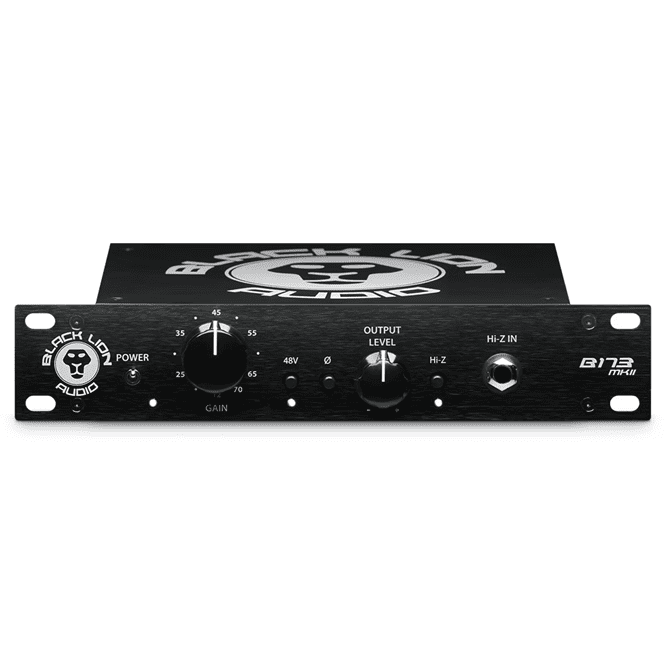
The Black Lion Audio B173 mkII review that follows is based on extended hands-on use of this preamp across a range of recording scenarios. The short version: it’s one of the most compelling pieces of outboard gear you can add to a home studio for under $300 — a genuine 1073-inspired circuit with Cinemag transformers that adds real analogue character to vocals, instruments, and synthesizers alike.
The Neve 1073 is one of the most imitated preamp designs in recording history — and for good reason. Its characteristic warm low end, smooth midrange, and present top end have coloured countless records since the early 1970s. The problem is that vintage 1073 modules trade for thousands of dollars, and even reputable modern reissues command prices that put them out of reach for most home studio producers. Black Lion Audio’s B173 mkII makes a compelling case that you don’t need to spend anywhere near that to get meaningfully into 1073 territory.
What it is
The B173 mkII is a single-channel Class A microphone preamplifier in a half-rack format, designed around the signal path of the Neve 1073. It’s Chicago-based Black Lion Audio’s second iteration of the design — the mkII upgrade over the original B173 brings Cinemag input and output transformers (replacing the original’s EDCOR output transformer), a revamped gain stage, and a lower noise floor. These are meaningful improvements: Cinemag transformers are well-regarded in professional audio circles, and the reduced noise floor gives you more clean headroom before the characteristic transformer saturation kicks in.
The half-rack format is worth understanding upfront. The B173 mkII is roughly the width of half a standard 1U rack space — you can mount two side by side in a single rack unit using Black Lion’s optional joining plate. On its own it sits neatly on a desktop or shelf. The power supply is an external wall-wart rather than being built into the chassis, which is one of the few concessions made to hit the price point.
Controls and connectivity
The front panel is clean and functional. From left to right you get: a power toggle, a large stepped input gain knob (up to 70dB of gain), a 48V phantom power button, a polarity reverse button, a variable output level attenuator, and a Hi-Z button with a corresponding front-panel instrument input jack. The stepped gain control is a key feature — it lets you dial in specific gain settings repeatably, which is useful when you want to return to a particular level of transformer saturation across sessions.
The rear panel carries the balanced XLR microphone input and a balanced TRS output jack. Note that the output is TRS rather than XLR — an unconventional choice that some engineers find mildly inconvenient, though it’s fully balanced and functionally identical. The external 24V AC power supply connects here too.
How it sounds
The B173 mkII delivers a convincing impression of the 1073 character — rich low end, a forward and present upper midrange, and a top end that’s slightly brighter and more open than the vintage reference. That last point is significant: the mkII isn’t a dark, vintage-sounding unit. It has a more modern quality to it while retaining the fundamental warmth and density that makes 1073-style preamps so appealing. Think of it as 1073-influenced rather than 1073-identical — which, for most home studio use cases, is exactly what you want.
The stepped gain and variable output attenuator work together to give you meaningful control over transformer saturation. At lower gain settings with the output attenuator backed off, the B173 mkII is clean and full-bodied. As you push the input gain higher and use the output attenuator to manage levels, the transformers begin to saturate in a way that adds density and harmonic richness — particularly useful on electric guitar DI, bass, and aggressive vocal takes where you want some grit and weight. On condenser microphones at moderate gain, the character is subtle: a pleasing warmth and three-dimensionality that flatters acoustic instruments and vocals without imposing itself.
The front-panel DI is a genuine highlight for a preamp at this price. It handles electric guitar, bass, keyboards, and synthesizers with a harmonically rich, full-bodied quality that significantly outperforms the DI inputs on most audio interfaces. Plugging a synthesizer through the B173 mkII DI and driving the transformers lightly adds an analogue weight that in-the-box processing rarely achieves.
What it’s missing
There’s no signal metering of any kind — no VU meter, no LED peak indicator. You’re working entirely by ear and by watching your DAW levels, which is fine once you’re familiar with the unit but takes some adjustment. The external wall-wart power supply is functional but inelegant, particularly if you’re racking the unit. And as noted, the output is TRS rather than XLR, which may require an adaptor cable depending on your patchbay setup.
At around $300, the B173 mkII is also a single channel — if you regularly need to track stereo sources or record a vocalist and guitarist simultaneously through coloured preamps, you’d need two units or a step up to the four-channel B173 Quad.
How it compares
At this price point, the B173 mkII’s closest competition comes from other budget 1073-inspired designs — the Golden Age Project PRE-73 MKIII (~$200) and the ART Pro MPA II (~$200 for two channels). The PRE-73 is a more straightforward Neve-inspired circuit but uses less refined transformers; the ART is a tube preamp with a fundamentally different character. The B173 mkII’s Cinemag transformers give it a genuine edge in component quality at the price, and the front-panel DI and stepped gain control add practical versatility that the competition doesn’t always match.
For producers who want to step up further, the Warm Audio WA73-EQ (~$600) offers a closer approximation of the full 1073 circuit including the EQ section. But for a home studio producer whose primary goal is adding analogue colour and transformer character to recordings without a major investment, the B173 mkII is the more practical choice.
Who it’s for
The B173 mkII makes most sense for home studio producers who want to add genuine analogue colour and transformer character to their recordings without the expense of boutique or vintage hardware. It’s particularly well-suited to vocals, electric guitar DI, bass, and synthesizers — sources where the 1073-style warmth and presence are most audible and most useful. If you’re currently running a condenser mic directly into an audio interface preamp and your recordings feel a little flat or clinical, the B173 mkII is the kind of upgrade that makes an immediately audible difference.
Our verdict
Black Lion Audio B173 mkII — Recommended.
- Price: ~$300 USD
- Type: Single-channel Class A mic preamp / DI
- Transformers: Cinemag input and output
- Gain: Up to 70dB (stepped control)
- Format: Half-rack (pairs with a second unit in 1U)
- Best for: Vocals, electric guitar DI, bass, synthesizers — anyone wanting 1073 character at a realistic home studio price
The B173 mkII won’t be mistaken for a vintage Neve in a blind test, but it delivers enough of that character — particularly that warm low end and forward upper-mid presence — to make a meaningful difference to your recordings. At around $300 it’s one of the most honest values in analogue preamplification for the home studio market.
Related reading: Getting Started With Home Recording | Focusrite Scarlett 2i2 Review | Choosing An Audio Interface | How To Choose A Great Microphone