
MusicTech.blog
Physical Modeling Synthesis Explained: Pianoteq, VL70-m, and Acoustic Simulation
August 5, 2025
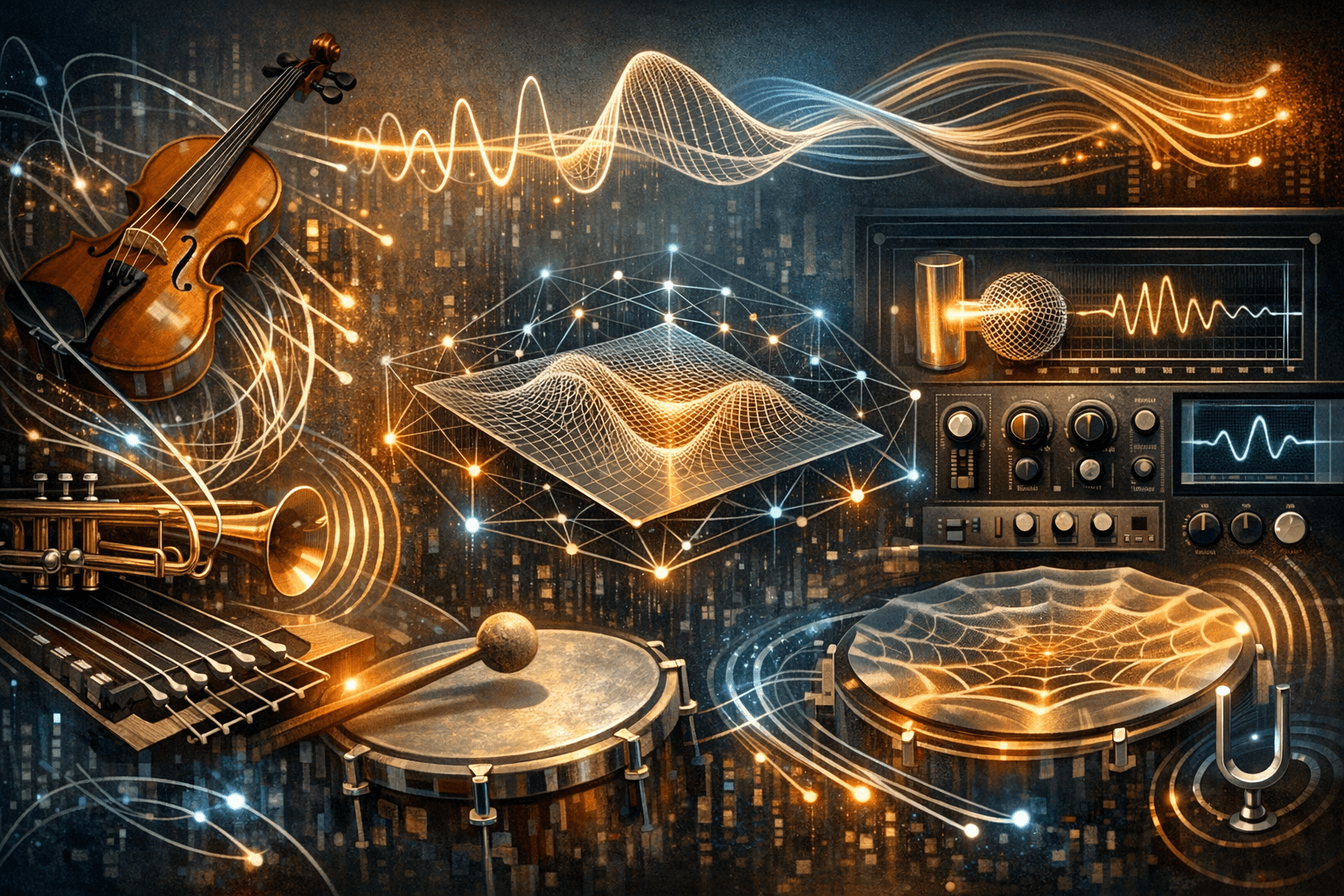
Physical modeling synthesis takes a fundamentally different approach from all other synthesis methods. Rather than using stored waveforms, mathematical operators, or recorded audio fragments, it simulates the physical behaviour of a real acoustic system in real time — the way a string vibrates, the way a reed responds to breath pressure, the way a drumhead resonates at its boundaries. The result can be extraordinarily realistic, and uniquely expressive in ways that sample libraries and other synthesis types cannot replicate.
The Core Concept: Simulating Physics
Every acoustic instrument produces sound through a physical process: a string vibrates at a frequency determined by its length, tension, and mass; a column of air in a tube resonates at frequencies determined by the tube’s length and shape; a membrane vibrates at modes determined by its size, tension, and material. Physical modeling synthesis represents these physical processes as mathematical equations and solves them in real time for every note, at every moment of the performance.
The advantage of this approach is continuous, physically coherent response to expressive input. A sampled piano plays back the recording of a note — the expressive shaping of that note through dynamics, pedaling, and subtle timing must be achieved through sample selection and crossfading. A physically modeled piano calculates the actual string behaviour for every moment of the note’s life, responding to damper pedal state, strike velocity, sympathetic resonance from adjacent strings, and the physics of the soundboard in real time. The result responds to expressive playing in ways that sampling can only approximate.
Karplus-Strong: The Algorithm That Started It
The simplest and most widely-known physical modeling algorithm is Karplus-Strong synthesis, developed by Kevin Karplus and Alex Strong in 1983. It simulates a plucked string with elegant simplicity: a short burst of noise (representing the pick or pluck impulse) is fed into a delay line whose length corresponds to the desired pitch, with a low-pass filter in the feedback path. The low-pass filter simulates the gradual loss of high-frequency energy as the string vibrates — exactly what happens as a real string loses energy to air friction and internal damping over time.
The result is a convincing plucked string sound — characteristically bright on the attack, with a natural exponential decay and a gradual darkening of tone as the note sustains. Karplus-Strong is computationally inexpensive and runs in real time on 1983-era hardware. It remains the foundation of many physical modeling string algorithms in current instruments.
Waveguide Synthesis: The Full Physical Model
Waveguide synthesis extends the Karplus-Strong concept into a complete physical model. Where Karplus-Strong approximates a plucked string with a simple feedback delay loop, waveguide synthesis models the full acoustic system — the excitation mechanism, the resonating body, and the radiation of sound — using digital waveguide networks that simulate acoustic wave propagation in both directions along a delay line. This bidirectional model captures the physics of wave reflection and interference at the instrument’s boundaries with accuracy that Karplus-Strong cannot achieve.
Yamaha’s Virtual Acoustic (VA) synthesis technology — used in the VL1, VL70-m, and EX5 — is the most commercially significant deployment of waveguide synthesis. The VL70-m models breath-controlled instruments (saxophone, clarinet, oboe, flute) and bowed strings (violin, cello) by simulating the physical interaction between the player’s embouchure and the instrument’s resonating body in real time. Breath pressure, tongue position, embouchure tension, and pitch bend all affect the model’s acoustic output in ways that directly parallel a real instrument’s response to a player’s physical gestures.
The expressive advantage for wind controllers is profound. Because the model simulates the physical causality of the instrument, it responds to continuous control data — breath pressure from a WX5 or Berglund controller, pitch bend, modulation — in a musically coherent way that emerges from the physics. Subtle pitch bending into a note, the tonal response to varying breath pressure, the squeak and crack of overblowing — these emerge from the model naturally rather than requiring explicit sample articulations for each variation.
Pianoteq: Physical Modeling Piano
Pianoteq (Modartt) is the most commercially successful physical modeling piano instrument and one of the clearest demonstrations of what physical modeling can achieve for keyboard instruments. Rather than storing thousands of audio samples, Pianoteq models the physics of the piano mechanism — hammer felt hardness, string length and tension, soundboard resonance, pedal damper physics, sympathetic resonance between strings, and the acoustic contribution of the instrument’s cabinet.
The practical advantages over sample libraries: Pianoteq installs in seconds (the executable is under 100MB versus the 50–300GB of high-quality piano sample libraries), responds to playing dynamics continuously rather than through discrete velocity layers, and allows physical parameters to be adjusted — changing the hammer hardness, string length, cabinet tuning, and microphone position to produce a range of piano characters from a single instrument model.
Pianoteq is also available for less common keyboard instruments — clavichord, harpsichord, vibraphone, marimba, tubular bells, and electric pianos — where the physical modeling approach captures the mechanical character of each instrument with exceptional accuracy. At the professional tier, Pianoteq is used on commercial recordings where its response to expressive playing outweighs the timbral accuracy advantage of top-tier sample libraries.
Modal Synthesis
Modal synthesis models percussion and resonant objects by simulating their vibrational modes — the specific frequencies at which an object naturally resonates when struck. Every physical object has a characteristic set of resonant frequencies determined by its shape, material, and dimensions. A bell rings at specific frequencies; a metal plate vibrates in patterns determined by its size; a wooden surface has a complex but consistent modal structure.
Modal synthesis captures this by building a bank of resonators — each tuned to one of the object’s modal frequencies with an amplitude and decay rate that matches the real object’s measured behaviour. When excited, each resonator rings at its frequency and decays at its characteristic rate, producing the complex, inharmonically rich spectrum of a real struck object. Applied Acoustics Systems’ Chromaphone uses modal synthesis for its resonator objects; the physical modeling percussion in many modern virtual drum instruments draws on similar principles.
Physical Modeling vs Sampling
Physical modeling and sampling represent opposite philosophical approaches to instrument reproduction. Sampling captures the actual sound of a real instrument at specific pitches, velocities, and articulations — the result is inherently accurate because it’s a recording, but it’s limited to the parameters that were recorded. Playing at a velocity or articulation not in the library requires interpolation between samples, which can sound mechanical under scrutiny.
Physical modeling generates sound from equations — it responds continuously to parameter changes in ways sampling cannot. Real-time pitch bending, continuous dynamics, subtle embouchure variation, and sympathetic resonance all emerge naturally from the model. The limitation is model accuracy: complex acoustic systems (large string ensembles, choir, pipe organ) involve acoustic interactions too complex to model convincingly with current computational approaches, and high-quality sample libraries remain more convincing for these instruments.
For piano, physical modeling has reached quality that competes with top-tier sampling — and for expressive playing applications, the continuous physical response of Pianoteq frequently surpasses what sampling can achieve. For solo wind instruments played through a breath controller, VA synthesis has no serious sampling competitor for expressive realism. The two approaches are complementary: physical modeling for expressive, continuous control; sampling for timbral accuracy in static or lightly expressive performance contexts.