
MusicTech.blog
Synthesizers Explained: Types of Synthesis, History, and How Synths Work
May 12, 2025
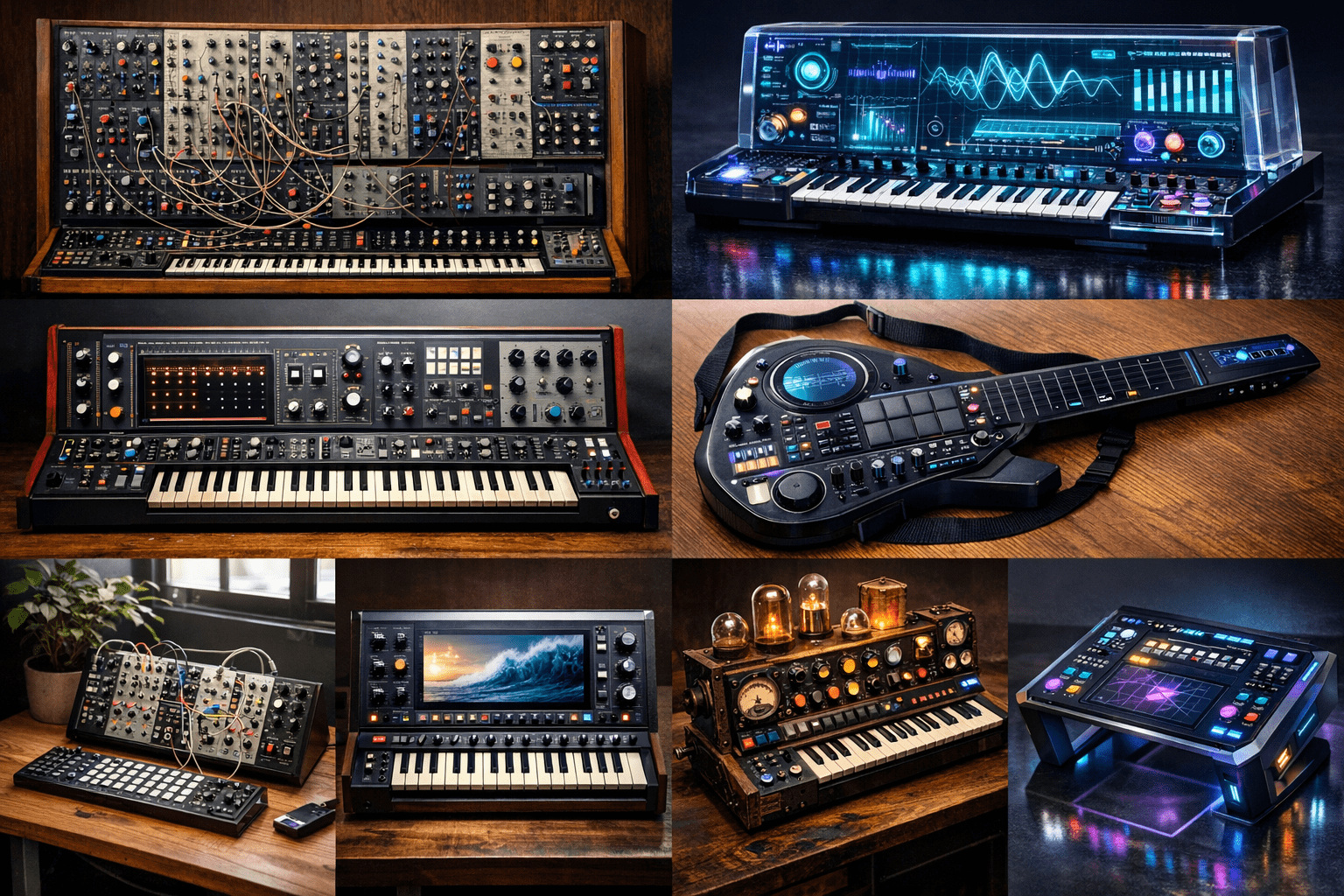
The synthesizer is the defining instrument of modern music. From the warm bass lines of 1970s funk to the icy arpeggios of 1980s pop, the acid squelch of early techno, the evolving pads of ambient music, and the hyper-detailed sound design of contemporary film scores — synthesis sits at the heart of almost every recorded genre. Yet for many producers, synthesizers remain intimidating: a sea of knobs, obscure terminology, and competing design philosophies.
This guide is your map. It explains what a synthesizer is, how the different synthesis types work, what the classic instruments were and why they mattered, and how synthesizers are controlled — from MIDI to CV to the expressive new world of MPE. Each section links to a deeper dive where you can go further.
What Is a Synthesizer?
A synthesizer is an electronic instrument that generates audio signals and shapes them into musical sounds. Unlike a sampler (which plays back recordings of real instruments) or a physical instrument (which produces sound through mechanical vibration), a synthesizer creates sound entirely through electronics — either analog circuits or digital algorithms.
A complete guide to synthesizers: how they work, the main types of synthesis, classic instruments and their history, and how synths are controlled via MIDI, CV, and MPE.All synthesizers share a common conceptual framework called the signal path:
- Sound source (oscillator) — generates a raw waveform: sine, sawtooth, square, triangle, or noise. This is the raw material.
- Filter — shapes the frequency content of the sound, typically subtracting harmonics to change the tone from bright to dark (or vice versa).
- Amplifier — controls the volume level of the signal over time.
- Modulation — LFOs and envelopes (particularly ADSR) animate and shape parameters over time — making the filter sweep, the amplitude fade, the pitch wobble.
- Effects — reverb, delay, chorus, distortion, applied at the end of the chain or within it.
Different synthesis types use different methods at the sound source stage. Everything else — filtering, modulation, effects — is largely shared across all types.
A Brief History of the Synthesizer
Electronic sound generation predates the synthesizer by decades — the Theremin (1928) and the Hammond organ (1935) were among the first widely-used electronic instruments. But the modern synthesizer begins in earnest in the 1960s with Robert Moog‘s voltage-controlled modular system and Don Buchla‘s parallel West Coast experiments. These instruments established the foundational concepts — oscillators, filters, envelopes, VCAs — that still define synthesizer architecture today.
The 1970s brought polyphonic synthesizers (the Sequential Circuits Prophet-5, the Oberheim OB-X), making synths viable live instruments. The early 1980s saw the explosion of digital synthesis with the Yamaha DX7 — an FM synthesizer so ubiquitous that its sounds defined a decade. Roland’s D-50 introduced linear arithmetic synthesis and sample-based attack transients. The late 1980s and 1990s brought workstation synths, virtual analog, and finally software synthesis, which opened up every synthesis type to anyone with a computer. Go deeper: Classic Synthesizers — A History of Iconic Instruments →
Types of Synthesis
Subtractive Synthesis
The most common and most approachable synthesis type. Subtractive synthesis starts with a harmonically rich oscillator (sawtooth, square, or pulse wave) and subtracts frequencies using a filter — carving the tone from a dense raw material. The Minimoog, Roland Juno-106, and Sequential Circuits Prophet-5 are canonical subtractive synthesizers, and the vast majority of modern analog-style soft synths follow this model. Go deeper: Subtractive Synthesis Explained →
Additive Synthesis
The opposite of subtractive: additive synthesis builds sounds by layering individual sine waves, each at a specific frequency and amplitude. Any sound can theoretically be reproduced by combining enough sine waves — this is the principle behind Fourier analysis. The Hammond organ is the most famous additive instrument. Modern additive synthesizers like the Kawai K5000 and software instruments like Camel Audio Alchemy offer full per-partial control. Go deeper: Additive Synthesis Explained →
FM Synthesis
Frequency Modulation synthesis uses one oscillator (the modulator) to modulate the frequency of another (the carrier) at audio rates, producing complex sidebands and harmonics that bear no obvious relationship to the input waveforms. The result is a distinctive, metallic, glassy, or bell-like quality that was impossible to achieve with subtractive synthesis. The Yamaha DX7 (1983) made FM synthesis famous; modern FM synthesizers include Native Instruments FM8, Yamaha’s FM-X engine (in the Montage), and the free Dexed plugin. Go deeper: FM Synthesis Explained →
Wavetable Synthesis
Wavetable synthesis stores a series of single-cycle waveforms in a table and plays them back, scanning or morphing between them to create evolving timbres. The PPG Wave (1981) pioneered the approach; Wolfgang Palm’s ideas have since been refined into some of the most popular soft synths of the modern era — Xfer Serum, Vital, and Native Instruments Massive. Wavetable synthesis excels at complex, animated digital textures. Go deeper: Wavetable Synthesis Explained →
Granular Synthesis
Granular synthesis decomposes audio into tiny fragments (grains) typically 1–100 milliseconds long, then reassembles them in ways that can radically transform the original material — stretching time without affecting pitch, creating dense clouds of texture, or producing sounds that bear no resemblance to their source. Pioneered theoretically by Iannis Xenakis in the 1950s and realized in software by Curtis Roads, granular synthesis is the engine behind much modern ambient, experimental, and film score sound design. Go deeper: Granular Synthesis Explained →
Physical Modeling Synthesis
Physical modeling synthesises sound by mathematically simulating the physical behaviour of a real instrument — the vibration of a string, the resonance of a tube, the behaviour of a reed. Rather than storing samples or generating waveforms, it computes sound in real time based on physical parameters. The Yamaha VL70-m modelled wind instruments; Modartt Pianoteq models piano acoustics with extraordinary realism. Physical modeling responds dynamically to playing nuances in ways that sample libraries often cannot. Go deeper: Physical Modeling Synthesis Explained →
Synthesizer Control: MIDI, CV/Gate, and MPE
A synthesizer’s sound engine needs a control interface — a way to tell it what notes to play, how loud, how long, and with what expression. Three main systems define this:
MIDI (Musical Instrument Digital Interface, 1983) is the universal standard — a digital protocol that carries note on/off, velocity, pitch bend, aftertouch, and continuous controller (CC) data. It’s the language all modern synthesizers, DAWs, and controllers speak. Standard MIDI is channel-based, meaning all notes on a channel share the same pitch bend and controller values.
CV/Gate (Control Voltage/Gate) is the analog predecessor — a voltage that controls pitch (typically 1 volt per octave) and a separate gate signal that triggers note on/off. CV/gate is the native language of modular synthesis (Eurorack) and many vintage analog instruments, and it remains essential in hardware-based studios where analog and digital gear needs to communicate.
MPE (MIDI Polyphonic Expression) is an extension to the MIDI standard that assigns each note to its own MIDI channel, allowing per-note pitch bend, slide, and pressure — enabling expressive, continuous control over individual notes within a chord. MPE is the technology behind instruments like the ROLI Seaboard, Linnstrument, and Haken Continuum. Go deeper: Synthesizer Control — MIDI, CV/Gate, and MPE Explained →
Embedded Effects in Synthesizers
Modern synthesizers — hardware and software — almost universally include onboard effects processing. These are not afterthoughts: they’re integral to the instrument’s sound. A Juno-106’s chorus is inseparable from its character. The reverb in a Roland D-50 patch defines how those sounds feel. The distortion in a Nord Lead shapes its aggressiveness.
Common onboard effects include chorus/flanger (modulation), reverb and delay (time-based), distortion and overdrive (saturation), EQ and filtering, arpeggiators, and step sequencers. In software synthesizers, the effects chain can be extensive — Omnisphere 3, for example, includes 58 onboard effects per layer. Understanding general effects processing (as covered in our Audio Effects Explained guide) informs how to get the most out of a synthesizer’s built-in tools.
Analog vs. Digital vs. Virtual Analog
Analog synthesizers generate and process sound using continuous voltage-controlled circuits. They have inherent instability, warmth, and character that arises from the behaviour of real components — slight tuning drift, filter saturation, the interaction of cascaded circuits. Many producers consider the analog signal path uniquely musical.
Digital synthesizers compute sound using DSP (digital signal processing). They are perfectly stable, highly flexible, and can implement synthesis types — FM, wavetable, granular, physical modeling — that are impractical or impossible in analog circuits. The tradeoff is a cleaner, sometimes characterless quality that requires effects and processing to warm up.
Virtual analog (VA) synthesizers are digital instruments that model the behaviour of analog circuits — introducing subtle imperfections, oscillator drift, and component-level warmth deliberately. The Access Virus, Roland JP-8000, and Nord Lead pioneered VA; modern soft synths like U-He Diva take the modeling to extraordinary depths.
Software Synthesizers and VST Plugins
Software synthesizers (VST/AU/AAX plugins) run inside a DAW and have largely democratised synthesis — any synthesis type is available for free or modest cost. Notable examples by type: Vital (wavetable, free), Dexed (FM, free), Surge XT (multitype, open source), Serum (wavetable), Pigments (multitype), Omnisphere 3 (multitype flagship). The line between hardware and software has blurred further with hardware synths offering DAW integration and software synths offering physical controllers.
DAW Spotlight: Synthesis in Cubase
Cubase ships with a capable built-in synthesizer suite. Retrologue 2 is a full-featured virtual analog synthesizer covering subtractive synthesis with two oscillators, a multi-mode filter, three envelopes, and two LFOs — a complete teaching instrument for the fundamentals. Padshop 2 is a granular and spectral synthesizer with a step modulator and extensive modulation routing. HALion Sonic covers sample playback, wavetable, and virtual analog synthesis in a workstation format. Together, they cover subtractive, granular, and sample-based synthesis without any third-party plugins.
Quick Tips to Carry Forward
- Start with subtractive synthesis — it’s the most approachable and teaches the signal path fundamentals that apply to every other type
- Learn one synthesizer deeply before exploring others — breadth without depth produces mediocre results
- The filter is the most important single element in a subtractive synth — spend time understanding it before touching anything else
- Envelopes and LFOs (modulation) transform a static patch into something alive — they’re as important as the oscillator
- Software synths are a perfectly valid starting point — Vital and Surge XT are free, full-featured, and genuinely excellent
- If you have Cubase, Retrologue 2 is already installed — it’s a complete synthesis education tool
Synthesizers reward curiosity and patience. The deeper you go into any one synthesis type, the more the underlying principles of sound and music theory illuminate what you’re hearing. Use the guides linked throughout this article as your next steps — each one goes deep into a specific thread.
For a comprehensive technical reference on synthesis methods, the Sound on Sound Synth Secrets series remains the gold standard — available at Sound on Sound.