
MusicTech.blog
Using Headphones In The Studio
March 7, 2025
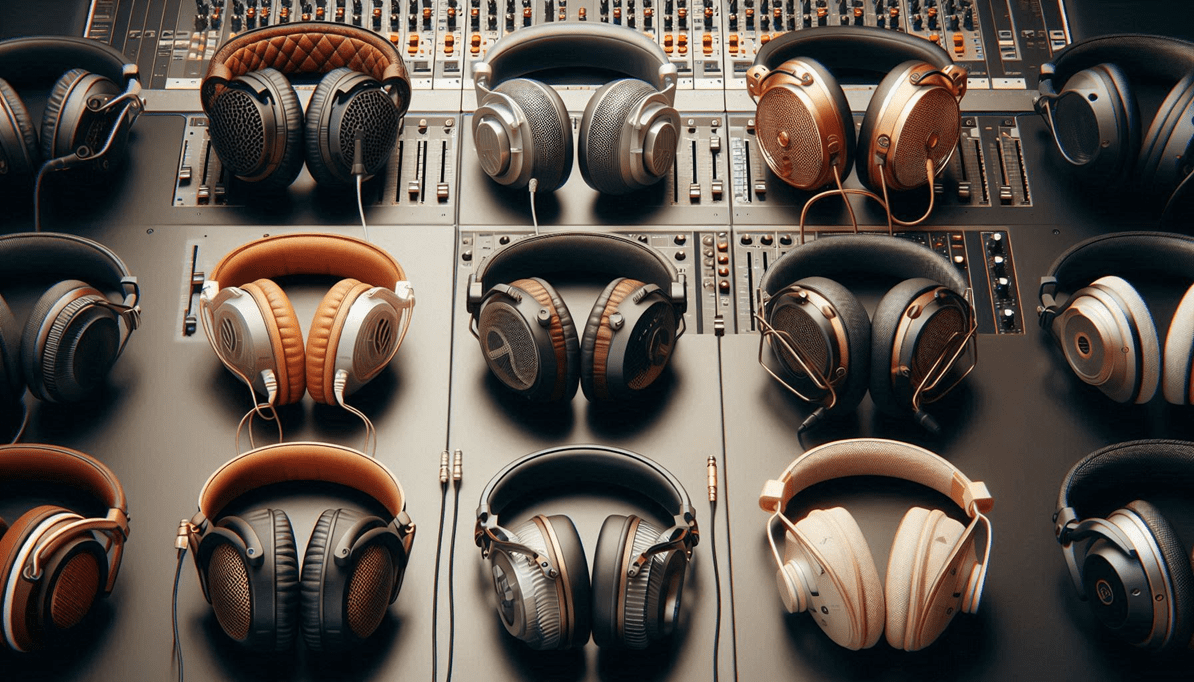
Studio headphones are often treated as a secondary monitoring option — something to reach for when you can’t use monitors, or when you need to work quietly late at night. But used correctly, they’re a genuinely valuable tool in any studio. Used incorrectly, they’ll mislead your mixes just as badly as poor monitors in an untreated room. The key is understanding which type of headphone does what, and when to use each.
Closed-Back vs Open-Back: The Most Important Distinction
Closed-Back Headphones
Closed-back headphones have sealed ear cups that prevent sound from leaking in or out. This makes them the right choice for tracking (recording) — the isolation means your microphone won’t pick up headphone bleed, and external noise won’t bleed into your recording environment. They’re also the practical choice for working in shared spaces, on location, or during late-night sessions.
The tradeoff is that the sealed design creates a slightly artificial stereo image — the soundstage tends to sound inside your head rather than in front of you, which makes stereo placement and width harder to judge accurately. Bass frequencies also tend to sound enhanced in closed-back designs because of the sealed acoustic environment, which can lead to under-compressed or over-EQ’d low end if you mix primarily on closed-backs.
Best for: recording sessions (tracking vocals, instruments), late-night work when monitors aren’t practical, commuting and travel, any situation where sound isolation is needed.
Recommended closed-back headphones:
- Sony MDR-7506 — the industry-standard tracking headphone, used in professional studios worldwide for decades. Flat, detailed, good isolation, foldable, and reliable. Not particularly comfortable for long sessions, but sonically honest and extremely well-proven.
- Beyerdynamic DT 770 Pro — more comfortable than the 7506 for long sessions, with a slightly warmer sound character. Available in multiple impedance versions (80Ω for most interfaces, 250Ω for use with headphone amplifiers).
- Audio-Technica ATH-M50x — popular entry-level choice with a slightly hyped low end that makes it less ideal for mixing but comfortable and enjoyable for tracking.
- Sennheiser HD 280 Pro — excellent isolation, relatively flat response, well-suited for tracking in noisier environments.
Open-Back Headphones
Open-back headphones have perforated or mesh ear cups that allow air and sound to pass through freely. This creates a more natural, spacious soundstage — the sound appears to come from around you rather than inside your head — which makes stereo imaging, width, and depth much easier to judge accurately. They’re significantly more useful than closed-backs for mixing work.
The tradeoff is obvious: they leak sound in both directions. Anyone nearby can hear what you’re listening to, and ambient noise enters from the environment. Open-backs are completely unsuitable for recording in the same room as a microphone, and impractical in any shared environment where the noise bleed would be a problem.
Best for: mixing reference checks, critical listening, extended sessions where fatigue is a concern, any situation where isolation isn’t needed and accuracy is the priority.
Recommended open-back headphones:
- Sennheiser HD 600 — the benchmark open-back reference headphone at a mid-range price. Exceptionally flat, detailed, and revealing — used by engineers and mastering professionals who do significant headphone work. Comfortable for very long sessions.
- Beyerdynamic DT 990 Pro — a slightly brighter, more energetic sound than the HD 600, which can be revealing on high-frequency content. Good soundstage. Available in 80Ω and 250Ω versions.
- AKG K702 — flat, wide soundstage, excellent spatial imaging. A strong mixing reference headphone at a price between the DT 990 Pro and HD 600.
- Sennheiser HD 650 — slightly warmer than the HD 600, preferred by some engineers for its more forgiving high end. Both the 600 and 650 are classics for a reason.
Semi-Open Headphones
Semi-open headphones attempt to split the difference — some isolation without the fully enclosed acoustic environment of a closed-back. In practice, they often end up being a compromise that’s not ideal for either tracking (insufficient isolation) or mixing (less natural soundstage than fully open). They’re worth considering if you genuinely need a single pair of headphones for both tracking and mixing in a home studio context, accepting that neither application will be served optimally.
Headphone Impedance and Amplification
Headphone impedance — measured in ohms (Ω) — affects how much power the headphone requires to reach listening volume. Low-impedance headphones (16–80Ω) are designed for use with devices that have limited output power — phones, laptops, portable players, and most audio interfaces. High-impedance headphones (150–600Ω) require more voltage to reach the same volume and are designed for use with dedicated headphone amplifiers.
The Beyerdynamic DT 770, DT 990, and similar models come in multiple impedance options. For use directly with an audio interface, choose the 80Ω version. For use with a dedicated headphone amplifier, the 250Ω version typically sounds slightly better due to better impedance matching with the amplifier’s output stage.
Most audio interfaces include a headphone output with sufficient power for low-to-mid impedance headphones. If you’re using high-impedance headphones and finding the volume insufficient or the sound thin, a dedicated headphone amplifier — even a modest one like the Schiit Magni or FiiO E10K — can make a meaningful difference.
Using Headphones Effectively for Mixing
Mixing entirely on headphones has genuine limitations — the unnatural stereo imaging makes it easy to misjudge panning, and the isolation from room acoustics removes some of the variables that affect how a mix translates to speakers. However, headphones are genuinely useful as a reference check alongside monitor listening, particularly for:
- Detail work — hearing fine detail in reverb tails, checking for noise, evaluating subtle high-frequency processing — is often easier on headphones than on monitors in a typical room
- Mono compatibility — summing to mono in headphones makes stereo width problems and phase issues immediately obvious
- Low-end reference — checking whether the bass and kick relationship makes sense on headphones provides a useful alternative perspective to monitor listening, since headphone bass response is less affected by room modes
- Consumer simulation — most listeners hear music on headphones or earbuds; checking your mix on open-back headphones gives you a sense of how it will translate to that context
Some software tools — including Waves Nx, Sonarworks SoundID Reference, and Slate Digital VSX — apply headphone correction and room simulation to make headphone mixing more reliable by compensating for the headphone’s frequency response and simulating speaker playback. These are particularly useful for producers who mix primarily on headphones by necessity.
Headphone Care and Maintenance
Studio headphones that see regular use need occasional maintenance. Ear pads degrade over time — the foam or velour compresses, the artificial leather cracks, and the acoustic seal is compromised. Replacement ear pads are available for virtually all professional headphones and typically cost $20–$50; replacing them restores the headphone’s original comfort and acoustic performance. For headphones like the Sennheiser HD 600 and Beyerdynamic DT series, replacement pads and headbands have been available for decades — these are headphones designed to last.
Keep headphones away from excessive moisture and store them in a case or on a headphone stand when not in use. The cables on most studio headphones are replaceable — a cable failure doesn’t mean the headphone needs to be replaced.
The Practical Setup: Two Pairs
The most effective headphone setup for a home studio is two pairs: one closed-back for tracking and one open-back for mixing reference. The Sony MDR-7506 (closed, for tracking) paired with the Sennheiser HD 600 (open, for mixing reference) represents a classic, well-proven combination that covers both applications properly at a total cost that’s accessible for most home studio budgets.
If budget constrains you to a single pair, choose based on your primary use: closed-back if you record live instruments or vocals and need isolation, open-back if you do primarily programmed or electronic music and mixing accuracy is the priority. Whichever you choose, treat it as a reference tool — something to cross-check your monitor work against, not a replacement for it.