
MusicTech.blog
FM Synthesis Explained: Operators, Algorithms, and the Yamaha DX7
July 8, 2025
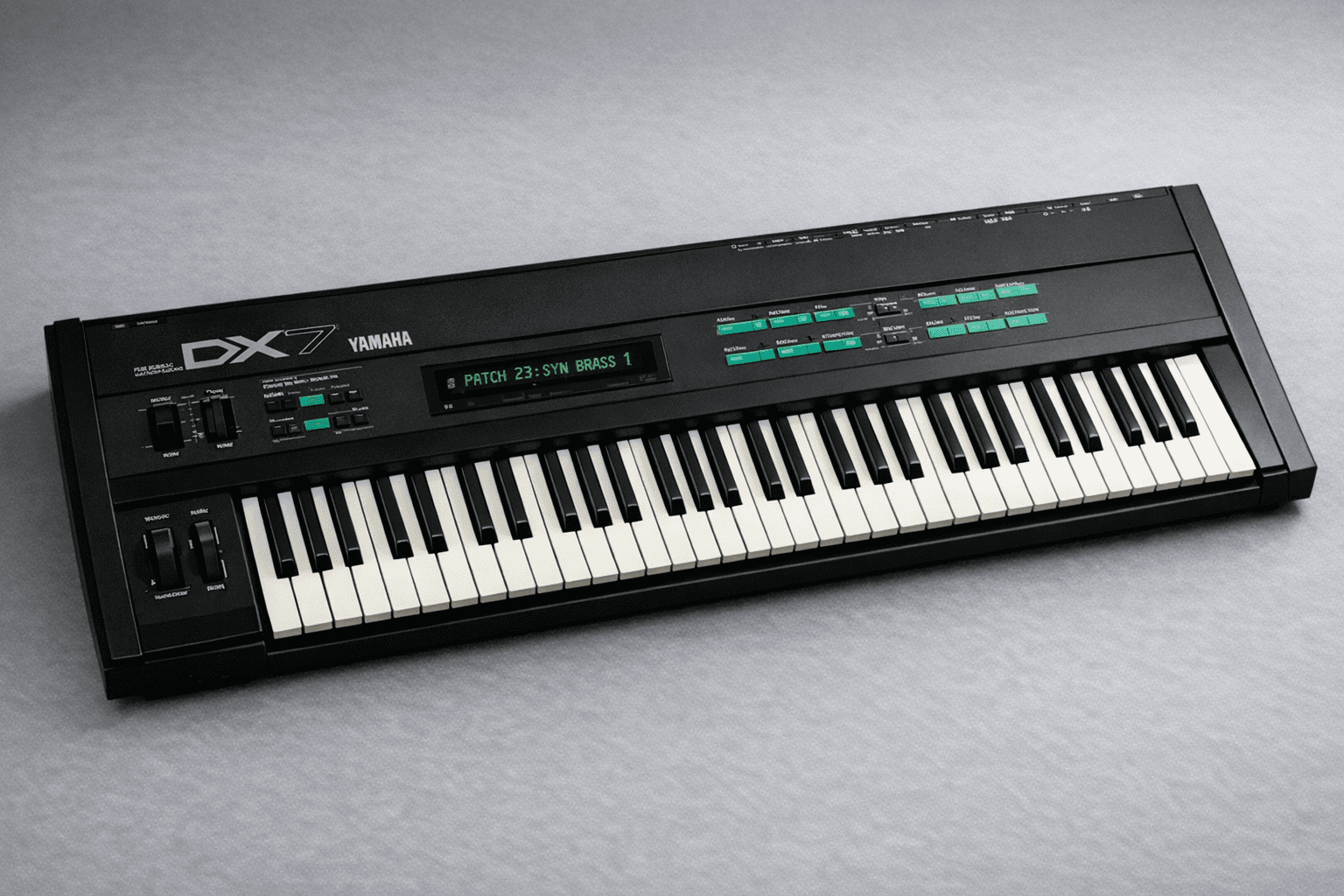
FM synthesis — frequency modulation synthesis — is one of the most sonically distinct and historically significant synthesis methods in electronic music. Where subtractive synthesis starts with harmonically rich waveforms and removes frequencies with filters, FM synthesis creates harmonic content through modulation: one oscillator varying the frequency of another at audio rates, generating complex new timbres from simple sine wave sources. The result can range from clean digital pianos and electric basses to aggressive metallic bells, evolving pads, and textures that no analogue synthesis method can reproduce.
FM synthesis became commercially dominant with the Yamaha DX7 in 1983 — one of the best-selling synthesizers in history — and its sound defined an era of popular music. Understanding how it works unlocks both the DX7’s legendary presets and the FM engines found in modern synthesizers like Native Instruments FM8, Arturia DX7 V, and the FM synthesis sections in Vital, Surge XT, and many others.
The Core Concept: Modulating Frequency at Audio Rates
In standard synthesis, a low-frequency oscillator (LFO) modulates a parameter like pitch, filter cutoff, or volume — the modulation rate is slow enough to hear as a cyclic change (vibrato, tremolo, wah). FM synthesis takes this concept and applies modulation at audio frequencies — typically hundreds or thousands of Hz — which moves beyond the perception of modulation as a cyclic effect and into the generation of entirely new harmonic content.
When oscillator B (the modulator) modulates the frequency of oscillator A (the carrier) at audio rate, the carrier’s output is no longer a simple sine wave. New frequency components — sidebands — appear at mathematically predictable positions above and below the carrier frequency. The number, position, and amplitude of these sidebands determine the timbre of the resulting sound. By controlling the frequency ratio between carrier and modulator, and the depth (index) of modulation, you control the harmonic content of the output.
Operators and Algorithms
In FM synthesis, individual oscillators are called operators. Each operator is a sine wave oscillator with its own pitch (expressed as a frequency ratio relative to the note being played), amplitude, and amplitude envelope (ADSR). The configuration of how operators connect to and modulate each other is called an algorithm.
Operators serve one of two roles:
- Carrier: an operator whose output goes directly to audio — you hear it
- Modulator: an operator whose output modulates the frequency of another operator — you hear its effect on the carrier, not the modulator itself
An operator can serve as both carrier and modulator simultaneously, depending on the algorithm. An operator that feeds back into itself is a feedback operator — feedback introduces additional harmonic richness and, at higher levels, a noise-like brightness.
The Yamaha DX7 provides six operators and 32 predefined algorithms — 32 different configurations of how those six operators connect. Algorithm 1 is a deep stack where operators modulate each other in sequence (maximum modulation complexity, good for metallic and inharmonic sounds). Algorithm 32 has all six operators as independent carriers (maximum unison voices, good for lush, organ-like sounds). The choice of algorithm fundamentally determines the character and complexity of the patches you can create from it.
The Modulation Index: Controlling Harmonic Complexity
The modulation index is the depth of frequency modulation — how much the modulator is varying the frequency of the carrier. At a modulation index of zero, there is no modulation and the carrier produces a pure sine wave. As the index increases, sideband components grow in amplitude and harmonic complexity increases. At high modulation indices, the spectrum becomes very dense and bright; at very high indices, the sound can become noisy or inharmonic.
Controlling the modulation index over time — using an envelope on the modulator’s amplitude — is how FM synthesis creates the evolving, dynamic timbres that define its sound. A classic FM electric piano patch uses a modulation index envelope that starts high (bright and percussive on the attack) and decays rapidly (leaving a softer, less harmonically complex sustain). The modulator envelope effectively controls the brightness envelope of the sound — a function served by the filter envelope in subtractive synthesis.
Frequency Ratios: Harmonic vs Inharmonic Sounds
The frequency ratio between carrier and modulator determines whether the sidebands fall on harmonic or inharmonic positions relative to the fundamental. Simple integer ratios (1:1, 1:2, 2:1, 1:3) produce harmonic sidebands that align with the overtone series — the result is a pitched, tonal sound with a defined fundamental. Non-integer ratios (1:1.41, 3:2.7, etc.) produce inharmonic sidebands that don’t align with the overtone series — the result is a metallic, bell-like, or atonal sound with an ambiguous pitch.
This relationship between frequency ratio and harmonic/inharmonic content is one of the most powerful tools in FM sound design. By choosing ratio 1:1, you get harmonically related sidebands suitable for basses, pianos, and organs. By choosing ratio 1:1.41 (√2), you get inharmonic content suitable for bells, metallophones, and aggressive lead sounds. Animating the ratio — slowly modulating it with an LFO — produces pitch instability and a sense of metallic movement that’s difficult to achieve with other synthesis methods.
The Yamaha DX7: Why It Mattered
The Yamaha DX7, released in 1983, was the first commercially successful FM synthesizer and became one of the best-selling synthesizers in history. It represented a dramatic departure from the analogue synthesis that dominated the market — no filters, no oscillators with variable waveforms, no traditional patch cables. Instead, six sine-wave operators, 32 algorithms, velocity and aftertouch sensitivity, and a 16-voice polyphony that was extraordinary for its time.
The DX7’s presets defined an era of popular music. The electric piano patch “E. Piano 1” appears on thousands of 1980s recordings. The bass patches were used on hit records from Michael Jackson to A-ha to Whitney Houston. The DX7 marimba, vibraphone, and bell sounds became production staples. The instrument’s ability to produce realistic-sounding electric pianos, basses, and mallet instruments at digital clarity — without the noise floor of analogue — made it commercially irresistible.
Its legacy extends to the present day. The DX7 SysEx format has been archived by the community; thousands of original DX7 patches are freely available and can be loaded into software emulations. Dexed (free) (free) is the most accurate software recreation and is fully DX7-compatible. Arturia DX7 V and Native Instruments FM8 offer DX7 compatibility with extended functionality.
FM Synthesis in Modern Instruments
FM synthesis has never gone away — it’s present in nearly every modern synthesizer either as a dedicated synthesis engine or as a modulation option within a larger hybrid architecture.
Native Instruments FM8
FM8 is an eight-operator FM synthesizer with a matrix-based operator routing system that provides far more flexibility than the DX7’s fixed algorithms. It includes an effects section, unison mode, and a comprehensive preset library covering the DX7 classic territory as well as more modern FM sound design. FM8 is DX7-compatible, loading original DX7 patches directly.
Arturia DX7 V
Arturia’s DX7 V combines an accurate DX7 emulation with additional modulation options, effects, and a more accessible interface that exposes the original’s parameters more clearly than the hardware’s original front panel. It loads original DX7 patches and provides a bridge between the classic instrument and modern FM sound design.
FM in Surge XT and Vital
Both Surge XT (free) and Vital include FM modulation options within their synthesis architectures. In Surge XT, oscillators can modulate each other in FM configurations within the existing architecture. In Vital, the wavetable oscillators can be frequency-modulated by other oscillators. These aren’t dedicated FM engines in the DX7 sense, but they make FM techniques accessible within a broader synthesis context.
Getting Started with FM Sound Design
FM synthesis has a reputation for being difficult to program — a reputation not entirely undeserved. The parameter interactions in a six-operator algorithm are complex, and small changes can produce dramatic results. The most effective way to learn FM sound design:
- Start with a simple two-operator patch (one carrier, one modulator). Increase the modulation index and listen to how the harmonic content changes. Change the frequency ratio and hear the difference between harmonic and inharmonic results.
- Animate the modulator amplitude envelope and hear how the attack, decay, and sustain of the modulator controls the brightness evolution of the sound over time.
- Load DX7 presets into Dexed and explore the parameters with the sound playing. Identifying which operator is doing what in a familiar preset is the fastest path to understanding FM architecture.
- Work with algorithms that have a clear carrier/modulator structure before tackling complex stacked algorithms where multiple operators modulate each other in chains.
FM synthesis rewards patience and systematic exploration. The sounds it produces — electric pianos, metallic percussives, evolving digital pads, aggressive leads — are genuinely unique and difficult to replicate convincingly with any other synthesis method. That specificity is both its limitation and its enormous creative value.