
MusicTech.blog
Focusrite Scarlett Solo vs 2i2: Which One Should You Buy?
February 12, 2026
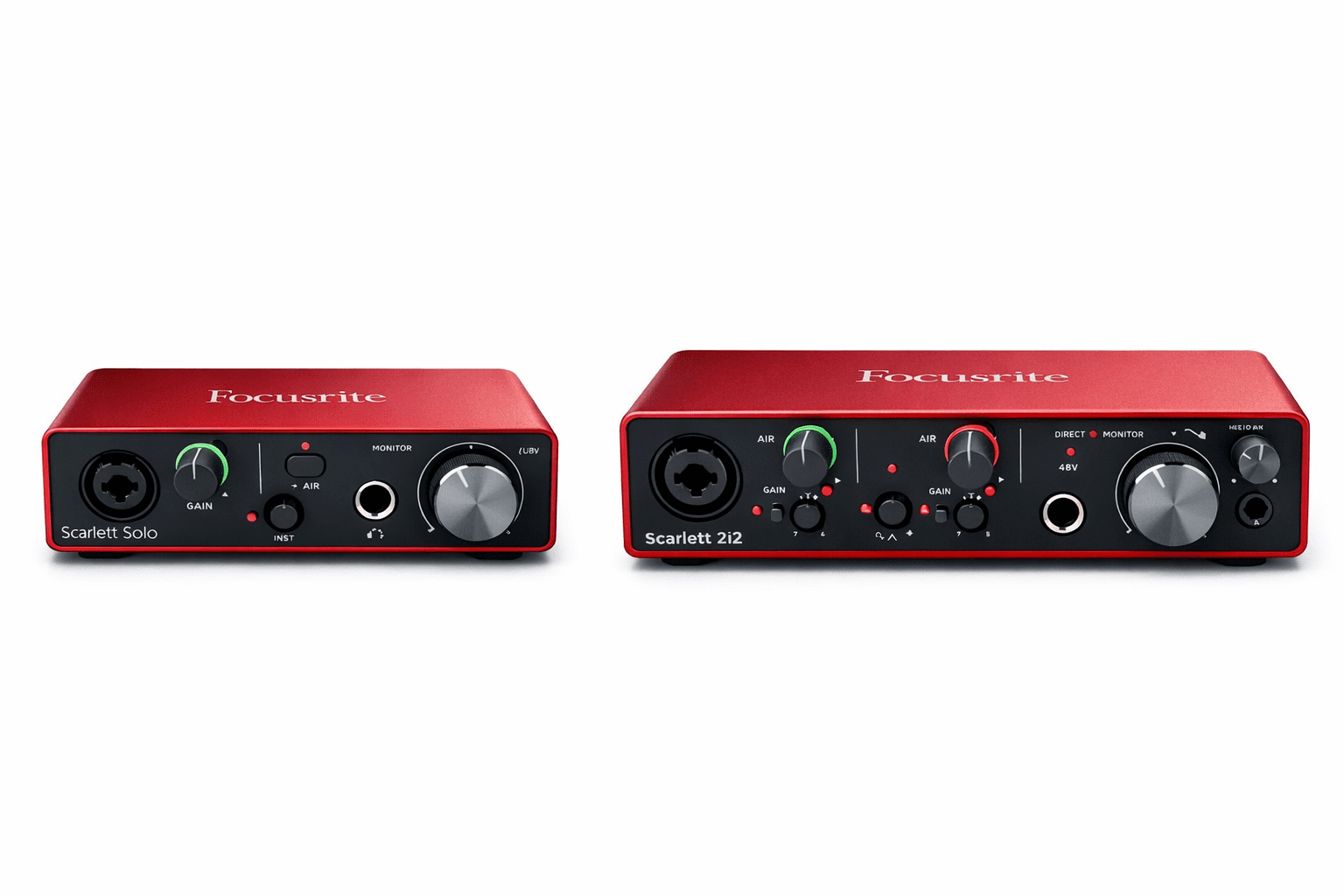
The Focusrite Scarlett Solo and Scarlett 2i2 are the two most popular entry-level audio interfaces in the world, and for good reason — both are genuinely excellent at what they do. They share the same 4th-generation preamp and converter technology, the same USB-C bus-powered design, and the same software bundle. But they serve different recording needs, and choosing the wrong one is a mistake that’s easy to make when you’re new to home recording.
This comparison breaks down exactly what’s different between the two, who each one is built for, and whether the price gap between them is worth it for your situation.
Specs at a Glance
Before diving into the differences, here’s how the two interfaces compare on paper:
| Feature | Scarlett Solo (4th Gen) | Scarlett 2i2 (4th Gen) |
|---|---|---|
| Mic preamps | 1 | 2 |
| Instrument inputs | 1 (front, dedicated) | 1 (front, combo jack) |
| Rear line input | No | Yes (1/4″ TRS) |
| Simultaneous inputs | 2 (1 mic + 1 instrument) | 2 (any combination) |
| Headphone outputs | 1 | 1 |
| Sample rate | Up to 24-bit / 192kHz | Up to 24-bit / 192kHz |
| Bus powered | Yes (USB-C) | Yes (USB-C) |
| Air mode | Yes | Yes |
| Direct monitoring | Mono only | Mono and stereo |
| Approximate street price | ~$119 USD | ~$169 USD |
What They Have in Common
Both the Scarlett Solo and 2i2 (4th Generation, released 2022) share the same core technology. Understanding this is important, because it means the choice between them is not about sound quality — it’s entirely about connectivity and workflow.
- The same class-A preamp design with Air mode — a high-frequency presence boost inspired by Focusrite’s ISA transformer-based studio preamps, which adds brightness and openness particularly useful for vocals and acoustic instruments
- The same 24-bit / 192kHz converters, which are excellent at this price point and hold their own against interfaces costing significantly more
- USB-C bus-powered operation — no external power supply needed, making both ideal for laptop-based and portable recording setups
- Plug-and-play compatibility with Windows (via the Focusrite ASIO driver) and macOS (Core Audio) — modern operating systems require no additional driver installation
- The same software bundle: Pro Tools Artist (3-month subscription), Ableton Live Lite, and a selection of Focusrite and third-party plugins including Antares Auto-Tune Lite
- The same solid aluminium housing that feels durable and professional and that has made the Scarlett line a fixture in home studios for over a decade
If you’re deciding between the two purely on sound quality, stop — the preamps and converters are identical. The differences are entirely about how many things you can connect at once and how you monitor what you’re recording.
The Key Differences Explained
Input Count: One Mic Preamp vs Two
The most fundamental difference: the Solo has one XLR microphone preamp input, while the 2i2 has two. This matters considerably more than it sounds.
With two preamps you can record two microphones simultaneously — a stereo pair on an acoustic guitar, two vocalists performing together, a vocal mic and a room mic, a dynamic mic and a condenser on the same source for blending. None of these are possible with the Solo. One mic at a time, full stop.
For a solo singer-songwriter who records one track at a time, one preamp is fine in practice. But the moment you have any ambition beyond that — even just wanting to capture the natural stereo width of an acoustic guitar with two mics — the Solo becomes a hard limit you can’t work around.
How the Inputs Are Arranged
The physical layout of the inputs differs between the two in a way that affects day-to-day use.
The Scarlett Solo has a dedicated XLR mic input and a dedicated 1/4″ instrument input on the front panel — two separate jacks, each with its own purpose. You can use both simultaneously: record a vocal and a DI guitar at the same time. That’s a legitimate two-channel recording scenario, but you’re always limited to one mic and one instrument.
The Scarlett 2i2 has two combo jacks on the front — each accepts either an XLR mic cable or a 1/4″ instrument cable. This means you can configure the two inputs however you need: two mics, two instruments, one mic and one instrument, or a mic and a line-level source via the rear input. The flexibility is meaningfully greater and lends itself better to evolving studio needs.
Direct Monitoring: Mono vs Stereo
Direct monitoring routes your input signal directly to your headphones with near-zero latency, bypassing the round-trip through your DAW. It’s how you hear yourself while recording without the distracting delay that appears when monitoring through software.
The Scarlett Solo only supports mono direct monitoring. Your input — whatever you’re recording — comes through centred in both ears. For vocals and single-instrument recording this is perfectly fine, but it means you can’t hear a stereo keyboard or stereo output in true stereo through the interface while tracking.
The Scarlett 2i2 adds a mono/stereo switch for direct monitoring. In stereo mode, input 1 comes through the left channel and input 2 through the right — which gives you a proper stereo image when monitoring a stereo source or when recording two mics in a stereo configuration. It’s a small quality-of-life difference that matters if you work with stereo keyboards, synthesizers, or hardware drum machines.
The Rear Line Input on the 2i2
The 2i2 includes a rear-panel line input — a balanced 1/4″ TRS jack — that allows you to connect a synthesizer, drum machine, mixer output, or other line-level source at proper line level rather than instrument level. This is a genuinely useful addition if you work with hardware gear.
The Solo has no equivalent. Connecting a synthesizer to the Solo means using the instrument input, which is designed for guitars and basses rather than line-level devices. It works, but you lose some headroom and the impedance matching isn’t ideal. For occasional use this is fine; for a hardware-centric setup it’s a consistent compromise.
Who Should Buy the Scarlett Solo
The Solo is the right choice if your recording needs are genuinely simple and unlikely to change:
- You are a solo vocalist or podcaster who records one microphone at a time, always, and has no interest in multi-mic recording or hardware instruments
- You record guitar and vocals into plugins — one DI guitar and one vocal mic, never simultaneously with a second mic
- You’re working to a tight budget and the $50 difference is meaningful right now, with the understanding that your setup may need upgrading sooner
- Portability is paramount — the Solo is marginally more compact and equally bus-powered, making it slightly easier to pack for travel recording
Who Should Buy the Scarlett 2i2
The 2i2 is the better choice for most home studio producers:
- You record acoustic instruments — acoustic guitar, violin, piano, upright bass, any instrument that benefits from a two-mic approach for a more natural stereo image
- You collaborate or record other musicians — two preamps means two vocalists, two instrumentalists, or any combination of the above
- You use hardware synthesizers or keyboards — the rear line input and stereo monitoring make the 2i2 a significantly better fit for hardware-centric setups
- You want room to grow — recording needs expand over time; the 2i2 gives you headroom that the Solo simply doesn’t
- You produce electronic music with hardware — drum machines, hardware synths, and outboard gear all benefit from the 2i2’s additional connectivity
- You’re uncertain about your future needs — which is most beginners, and the 2i2 is the safe choice in that situation
Is the Price Difference Worth It?
For the majority of home studio producers: yes. The Scarlett 2i2 costs roughly $50 more than the Solo at most retailers, and what you get for that premium is meaningful — a second mic preamp, stereo direct monitoring, a rear line input, and the flexibility to grow into your setup without immediately needing to replace the interface.
The economics are straightforward: if you buy the Solo and later find you need a second preamp, you’ll pay the full price of a 2i2 (or equivalent) and deal with reselling the Solo at a loss. Buying the 2i2 upfront costs $50 more once. That’s not a close calculation for most people.
The Solo makes clear sense only if you are genuinely, permanently, only-ever going to record one microphone at a time — and you’re confident of that. That describes some people: dedicated solo podcasters, vocalists who only record themselves, producers who work entirely with virtual instruments and never touch a microphone. But it doesn’t describe most home studio producers, who tend to find their setups expanding as they get more comfortable with recording.
What If You Need More Than Two Inputs?
Both the Solo and 2i2 are two-channel interfaces at their core — two simultaneous inputs is the ceiling. If you need more, neither will serve you for long.
The next step up within the Scarlett range is the Scarlett 4i4 (four inputs, MIDI I/O, balanced outputs), followed by the Scarlett 8i6 and Scarlett 18i20 for larger setups. Outside of Focusrite, interfaces worth considering at the next tier include the Audient iD14 mkII, SSL 2+, Universal Audio Volt 476, and PreSonus Studio 68c.
For recording a drum kit with multiple mics, tracking a band live, or running a more complex hybrid studio with extensive outboard gear, you’ll need to move up to four or more preamps. But for the vast majority of home studio producers — those recording vocals, guitars, keyboards, and virtual instruments — the 2i2’s two inputs are more than sufficient and will stay sufficient for years.
Verdict
The Scarlett Solo and 2i2 are both excellent interfaces. The preamp quality, converter performance, build quality, and software bundle are identical. The sound going in and out of both is indistinguishable.
Buy the Scarlett Solo if you genuinely only need one microphone input and are confident that won’t change. It’s a capable, compact, good-value interface for that specific use case.
Buy the Scarlett 2i2 if you have any ambiguity about your needs, work with hardware instruments, record acoustic sources, or simply want the flexibility that comes with two proper preamps. For most home studio producers, the 2i2 is the right answer — and the $50 difference is worth paying once rather than paying the full upgrade cost later.