
MusicTech.blog
Best Free VST Plugins in 2026: Synths, Effects and Utilities
March 11, 2026
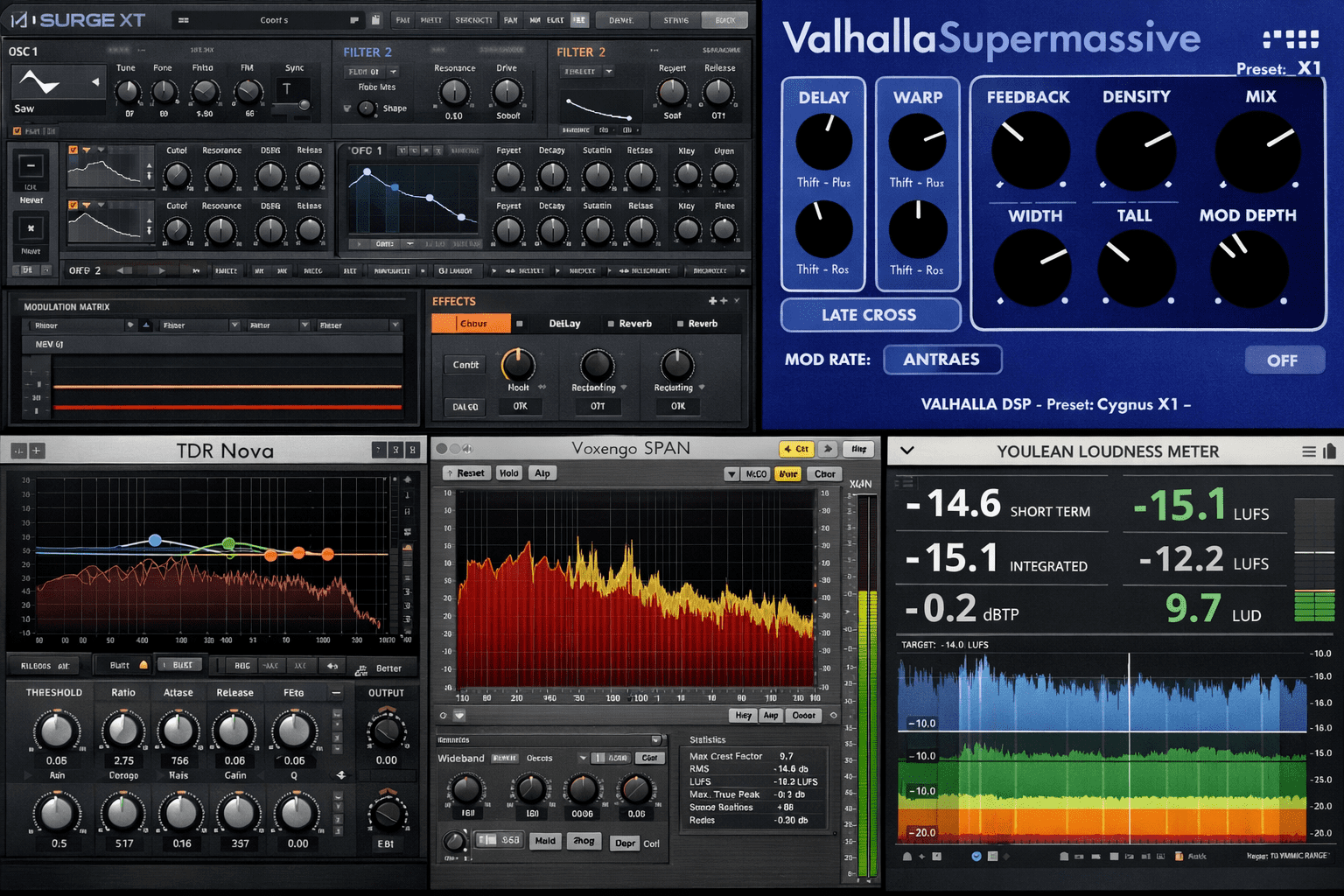
The free VST plugin market has never been better. Developers release genuinely professional-quality instruments, effects, and utilities at no cost — some as commercial demos with full functionality, others as permanent community contributions. The challenge isn’t finding free plugins; it’s finding the ones worth your time among the noise.
This guide covers the best free VST plugins available in 2026, tested across Cubase, Ableton, FL Studio, Reaper, and where applicable, Logic Pro. Every plugin listed here is actively maintained, widely compatible, and earns its place in a serious studio — not just something to fill your plugin folder.
Free Synthesizer Plugins
Surge XT
Surge XT is the most fully-featured free synthesizer available, and it isn’t close. Originally a commercial product from Vember Audio, it was open-sourced and is now developed by a dedicated community that releases updates regularly. It includes wavetable, FM, subtractive, additive, and window synthesis engines — multiple engines can be layered within a single patch — alongside one of the most comprehensive modulation systems in any synthesizer at any price. A vast library of community-contributed presets covers everything from classic analogue emulations to aggressive sound design and cinematic textures.
Surge XT runs on Windows, macOS, and Linux, supports VST3, AU, CLAP, and standalone operation, and is actively developed with frequent updates. If you install only one free synthesizer, this is the one. Available at surge-synthesizer.github.io.
Vital
Vital is a spectral warping wavetable synthesizer with one of the best user interfaces in the synthesizer world — clean, visual, and immediately readable in a way that makes the connection between parameter and sound obvious. The free tier includes three wavetable slots, a full modulation system with drag-and-drop routing, a high-quality effects chain (reverb, delay, chorus, distortion, EQ, compressor, filter), and a growing preset library.
What distinguishes Vital from other wavetable synthesizers is the spectral warping feature — the ability to apply FFT-based transformations to wavetables in real time, producing textures and evolutions that aren’t possible through standard wavetable scanning. The modulation visualisation (every modulated parameter shows the modulation depth as a shaded arc in real time) makes programming fast and intuitive. Available at vital.audio.
Dexed
Dexed is a faithful software recreation of the Yamaha DX7, the FM synthesizer that defined the sound of 1980s pop and electronic music. It’s compatible with original DX7 SysEx patch banks — you can load thousands of classic DX7 presets that have been archived by the community over four decades. The interface mirrors the DX7’s operator architecture, and the sound quality is excellent: convincing electric pianos, metallic percussion, glassy pads, and the distinctive DX7 bass that powered countless records.
For anyone wanting to explore FM synthesis or access the enormous library of existing DX7 patches, Dexed is the definitive free option. Available at github.com/asb2m10/dexed.
OB-Xd
OB-Xd is a free emulation of the Oberheim OB-X and OB-Xa — polyphonic analogue synthesizers from the late 1970s and early 1980s that produced some of the warmest, most musical pads, strings, and leads in synthesis history. The emulation captures the character well, including the mild oscillator instability and filter behaviour that make the originals sound alive. A substantial bank of community presets covers the classic OB-X territory: lush strings, fat basses, evolving pads, and punchy polyphonic leads. Available at github.com/reales/OB-Xd.
Helm
Helm is an open-source polyphonic synthesizer from Matt Tytel — the same developer who later created Vital. Its architecture is more straightforward than Vital’s: two oscillators, a filter section with multiple filter types, a comprehensive modulation system with a visual modulation matrix, and a built-in effects chain. It’s an excellent synthesizer for producers learning subtractive synthesis, because the signal flow is clear and the connection between each parameter and the resulting sound is easy to follow. Runs on Windows, macOS, and Linux. Available at tytel.org/helm.
Free Effects Plugins
TDR Nova (Tokyo Dawn Records)
TDR Nova is a parallel dynamic equaliser — it combines a standard parametric EQ with dynamic EQ capability on each band, allowing individual frequency bands to compress or expand based on the signal level at that frequency. This makes it extremely useful for mix-bus processing, vocal control, and solving complex frequency masking problems that static EQ alone can’t address elegantly.
The free version is fully functional with four dynamic EQ bands plus a high-pass and low-pass filter. The paid GE (Gentleman’s Edition) adds additional bands and features, but the free version is genuinely professional and competes with many paid dynamic EQ plugins. For mixing, it’s arguably the most useful free plugin on this list. Available at tokyodawn.net.
Valhalla Supermassive
Valhalla makes some of the most respected reverb and delay plugins in the industry — Room, Vintage Verb, Delay, and Plate are all industry standards. Supermassive is their permanently free plugin, and it’s exceptional: a reverb and delay plugin specifically designed for large spaces, extreme modulation, and lush, evolving textures. The decay times extend to the absurd — up to hundreds of seconds — making it ideal for ambient music, cinematic sound design, and adding space to anything from a snare to a full mix.
The algorithm selection covers a range of characters from relatively conventional large-hall reverbs to completely otherworldly spatial effects. It sounds dramatically better than most reverbs costing fifty times as much. Available at valhalladsp.com.
Chow Matrix
Chow Matrix is a free delay plugin that takes a fundamentally different approach to delay — instead of a single delay line with standard tap and feedback controls, it provides a node-based routing system where you create a network of delay taps with individual feedback, panning, distortion, and filtering controls. Complex rhythmic delay patterns, pseudo-reverb spaces built from delay networks, and evolving stereo delay textures that are difficult or impossible to achieve with conventional delay plugins are all straightforward to design.
There’s a learning curve to the interface, but for producers interested in creative delay and sound design, Chow Matrix is genuinely unique. Available at github.com/Chowdhury-DSP/ChowMatrix.
ADHD Leveling Tool
The ADHD Leveling Tool is a free optical compressor emulation with a simple, focused interface — input gain, threshold, and output gain, with the compression character determined by an analogue-style optical circuit model. It adds warmth and gentle dynamic control in a way that’s difficult to describe technically but immediately obvious when you hear it on a vocal, bass, or acoustic instrument. It’s one of those plugins that makes everything it touches sound slightly more alive. Available as a free download from ADHD Musik.
Limiter No6 (vladg/sound)
Limiter No6 is a free mastering limiter and loudness processor that’s more capable than several paid alternatives. It includes an RMS compressor, a peak limiter, a high-frequency limiter, a clipper, and a true-peak limiter — each module can be used independently or chained in sequence. For mastering to streaming targets (Spotify, Apple Music, YouTube all apply loudness normalisation), having a true-peak limiter that catches intersample peaks is important, and Limiter No6 handles this correctly. Available at vladgsound.wordpress.com.
OrilRiver
OrilRiver is a free algorithmic reverb that punches well above what its price tag (nothing) would suggest. It offers a range of room sizes from small ambiences to large halls, with controls for pre-delay, diffusion, high and low damping, and stereo width. The sound is smooth and musical without the metallic artefacts that plague many budget reverbs. It’s not Valhalla Room, but it’s a genuinely good-sounding reverb for general mixing use and far better than any stock reverb in most DAWs. Available at denis.a.blank.ru.
Free Utility Plugins
SPAN (Voxengo)
SPAN is a free real-time spectrum analyser from Voxengo — one of the most respected plugin developers for analytical tools. It shows you the frequency content of your mix as it plays, which helps identify problem frequencies, check the balance between lows, mids, and highs, and compare your mix against commercial references. SPAN includes a correlation meter (for checking mono compatibility), RMS and peak metering, and a configurable display with adjustable resolution, averaging, and slope. It’s the standard recommendation for a free spectrum analyser and is genuinely professional in its accuracy and usefulness. Available at voxengo.com.
Youlean Loudness Meter
Streaming platforms apply loudness normalisation — they turn your track up or down to match a target loudness level, typically around -14 LUFS for Spotify and -16 LUFS for Apple Music. If your master is too loud, it gets turned down and you lose dynamic range for no benefit. If it’s too quiet, it sounds thin compared to other tracks in a playlist.
Youlean Loudness Meter shows your track’s integrated loudness in LUFS, true-peak levels, and loudness range — the three figures you need to master for streaming correctly. The free version is fully functional for all practical mastering purposes. Available at youlean.co.
MeldaProduction Free Bundle
MeldaProduction offers a free bundle of over 30 plugins that includes compressors, EQs, oscilloscopes, a tuner, saturators, and several creative effects. The individual plugins are genuinely useful — MCompressor, MEqualizer, and MTuner in particular are professional-quality tools. The interfaces are dense and can be overwhelming at first, but the underlying algorithms are solid and the bundle represents exceptional value for zero cost. Available at meldaproduction.com.
Auburn Sounds Graillon 2
Graillon 2 is a free vocal processing plugin that does two things particularly well: pitch correction and pitch shifting with a formant-aware algorithm that avoids the chipmunk effect that plagues naive pitch shifting. The free version includes the pitch correction module, which is useful for subtle tuning work without the tell-tale artefacts of cheaper pitch correction tools. The paid version adds a bitcrusher and more formant control, but the free tier is genuinely functional. Available at auburnplugins.com.
Free Sample-Based Instruments
Decent Sampler
Decent Sampler is a free sample player plugin — in itself modest, but the ecosystem around it is extraordinary. The Pianobook community (founded by composer Hans Zimmer and developer Christian Henson) hosts hundreds of free sample libraries specifically built for Decent Sampler, including piano recordings, orchestral instruments, experimental textures, world instruments, and one-of-a-kind sounds recorded by musicians around the world. The plugin itself is clean, performant, and easy to use. Together, Decent Sampler and the Pianobook library represent one of the most generous free resources in music production. Available at decentsampler.com; libraries at pianobook.co.uk.
MT-Power Drum Kit 2
MT-Power Drum Kit 2 is a free acoustic drum sampler that sounds dramatically better than its price suggests. The samples are recorded from a real acoustic kit with multiple velocity layers and round-robin sampling (multiple samples of the same hit played in rotation to avoid the machine-gun effect of repetitive samples). The mixer includes individual channel control over the kit pieces with adjustable ambience. For demo recordings, songwriting, and any context where a realistic-sounding acoustic drum kit is needed without the budget for a commercial sample library, this is the standard recommendation. Available at powerdrumkit.com.
Getting the Most From Free Plugins
A few practical notes on working with free plugins:
- Keep them updated. Free plugins from active developers receive regular updates that fix bugs and add features. Surge XT, Vital, and the Chow plugins in particular update frequently.
- Watch for 32-bit-only plugins. Most modern DAWs are 64-bit and won’t load 32-bit plugins without a bridge. Stick to 64-bit plugins unless you have a specific reason to use older ones.
- VST3 is the current standard on Windows. Prefer VST3 over VST2 when both are available — VST3 is more efficient, handles deactivation better, and is the format actively maintained by Steinberg going forward.
- Don’t overcollect. A folder full of plugins you don’t understand is less useful than ten plugins you know deeply. Focus on learning a small set of excellent free plugins thoroughly before expanding.
The plugins on this list cover every essential category: synthesis, reverb, delay, compression, EQ, metering, sampling, and drums. A home studio built entirely around free plugins using this list as a foundation can produce results indistinguishable from studios running tens of thousands of dollars of software — and in most cases, the limiting factor won’t be the tools.
Further Reading
- Synthesizers Explained: Types of Synthesis, History, and How Synths Work
- Subtractive Synthesis Explained: Oscillators, Filters, and Envelopes
- Wavetable Synthesis Explained: PPG Wave, Serum, and Morphing Sound
- Granular Synthesis Explained: Grains, Textures, and Sound Design
- EQ Explained: How to Shape Tone and Fix Problems in Your Mix
- How to Use Compression: A Beginner’s Guide