
MusicTech.blog
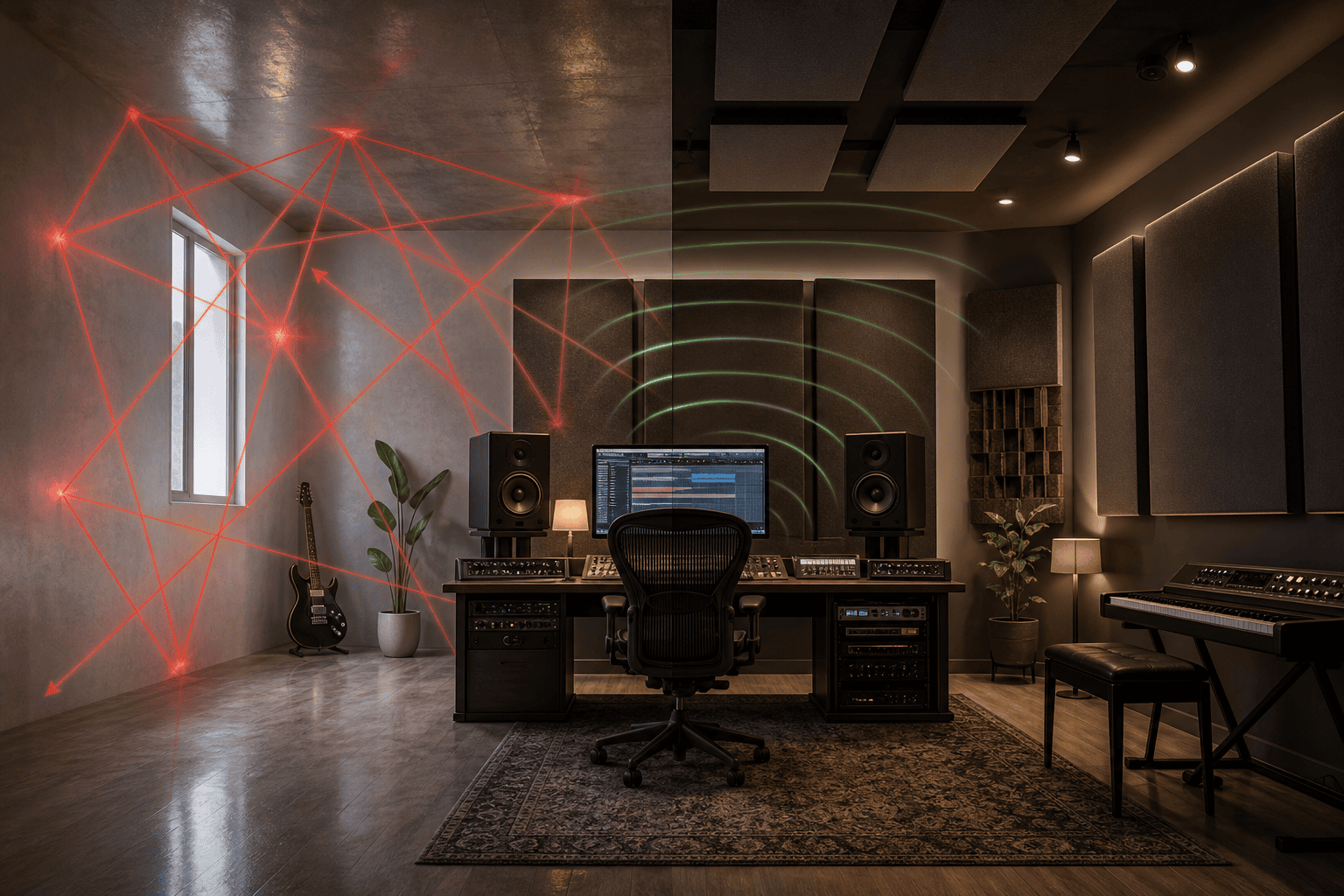
Room acoustics are the single most overlooked factor in home recording, and the fastest way to explain why is this: two identical mixes, played in two different rooms, will sound like two different mixes.
If you’ve ever finished a mix you were proud of, only to have it fall apart in the car, on a friend’s Bluetooth speaker, or on a pair of cheap earbuds, the problem probably wasn’t your ears, your plugins, or your talent. It was your room.
Room acoustics are the most overlooked variable in home recording, and arguably the one with the biggest return on investment. None of your gear matters if the room you’re listening in is actively lying to you.
What Room Acoustics Actually Means
Room acoustics describes how sound behaves once it leaves your speakers and interacts with the surfaces around it. Sound bounces off every hard surface and arrives at your ears milliseconds later as a jumble of reflections layered on the original signal.
Your brain ignores this in everyday listening, but not when judging reverb tails or low-end balance. Untreated rooms actively distort the frequency and stereo information you rely on, without you noticing.
The Problems an Untreated Room Creates
Standing Waves and Room Modes
Every room has dimensions that create resonant frequencies called room modes. When a sound wave’s wavelength matches the distance between two parallel surfaces, it reinforces certain frequencies and cancels others. Small, roughly square rooms tend to have the worst mode problems.
Flutter Echo
Stand between two parallel, untreated walls and clap once. If you hear a rapid, metallic tail rather than a single clean sound, that’s flutter echo. It smears transient detail and makes it hard to judge the true decay of reverbs and delays.
Comb Filtering and Early Reflections
When a reflected sound arrives at your ears a few milliseconds after the direct sound, the two interfere, boosting some frequencies and cancelling others. This is why home studio mixes often end up thin, hollow, or overly bright.
Bass Buildup in Corners
Low frequencies are omnidirectional and have long wavelengths, so they tend to pile up in room corners, where two or three boundary surfaces meet. This is why bass often sounds tighter near a wall corner than in the middle of the room.
Acoustic Treatment vs. Soundproofing: Two Different Jobs
Acoustic treatment and soundproofing solve different problems. Soundproofing stops sound from entering or leaving a room, relying on mass, decoupling, and sealing air gaps. Acoustic treatment controls how sound behaves inside a room, relying on absorption, diffusion, and bass trapping.
The Three Core Tools of Room Treatment
Absorption
Absorptive materials like rigid fibreglass or mineral wool convert sound energy into a small amount of heat, reducing the level of reflections. Absorption is most effective at mid and high frequencies unless the panel has enough depth to reach lower.
Diffusion
Diffusion breaks up reflections and scatters them in multiple directions rather than eliminating them, preserving a sense of space instead of making a room feel acoustically dead. Diffusers work well on rear walls, behind the listening position.
Bass Trapping
Bass traps are thicker, denser absorptive units — often corner-mounted — designed to tame low-frequency buildup that thinner panels can’t touch. Because bass problems are usually the most damaging to mix translation, bass traps are frequently the highest-priority purchase in a treatment plan.
A Practical, Budget-Conscious Treatment Plan
You don’t need to treat an entire room to get a meaningful improvement. Prioritize in this order:
1. Start With the Mix Position
The area directly around your ears at the mixing position matters more than anywhere else in the room. Get this wrong and no amount of treatment elsewhere will save you.
2. First Reflection Points
Have someone slide a mirror along the side walls, ceiling, and desk surface while you sit in your mix position. Anywhere you can see the speaker cones in the mirror is a first reflection point, and that’s where a panel needs to go.
3. Corners for Bass Control
Floor-to-ceiling corner bass traps in the front corners of the room typically deliver the single biggest audible improvement per dollar spent.
4. Rear Wall Diffusion
Once the front of the room is under control, a diffuser on the rear wall helps maintain a natural sense of space without reintroducing flutter echo.
5. Ceiling Clouds
An absorptive panel mounted above the mix position tackles the vertical reflection path between your monitors, the ceiling, and your ears — often neglected compared to side walls.
DIY vs. Commercial Acoustic Panels
Commercial panels from brands like GIK Acoustics, Auralex, or Primacoustic offer consistent, tested performance and come pre-finished. DIY panels built from rigid fibreglass, wood frames, and acoustically transparent fabric can deliver comparable performance at a fraction of the cost for anyone comfortable with basic woodworking.
Either route works. The mistake to avoid is buying thin, decorative foam tiles marketed for soundproofing — they do very little for low or mid frequencies.
How Room Acoustics Quietly Undermines Your Mixes
An untreated room causes mixing engineers to make compensating decisions rather than correct ones. If your room falsely emphasizes 200 to 300Hz, you’ll instinctively scoop that range out of every mix, and your tracks will sound thin everywhere except your own room.
Testing Your Room
Free tools like Room EQ Wizard (REW), paired with a measurement microphone, let you generate a frequency response graph of your actual listening position. Even without measurement software, the clap test for flutter echo reveals a lot about where your problem frequencies live.
Where to Start
Acoustic treatment is not an optional upgrade you get to once the gear budget is spent — it’s the foundation that determines whether every other purchase in your signal chain is worth making. Start with bass trapping in the front corners and first-reflection panels at your mix position. Everything else can wait.
Explore the Full Acoustics Series
This pillar guide is the hub for a full series on home studio acoustics. Dig deeper into any of these:
- Bass Traps Explained: Do You Really Need Them?
- How to Find Your First Reflection Points (The Mirror Trick)
- DIY Acoustic Panels: A Step-by-Step Build Guide
- Room EQ Wizard (REW) Setup Guide for Home Studios
- Symmetrical vs. Asymmetrical Studio Layouts
- Vocal Booth on a Budget: Isolation vs. Treatment for Recording
- Acoustic Treatment for Apartments and Shared Spaces
- Why Your Mixes Sound Great at Home and Bad Everywhere Else