
MusicTech.blog
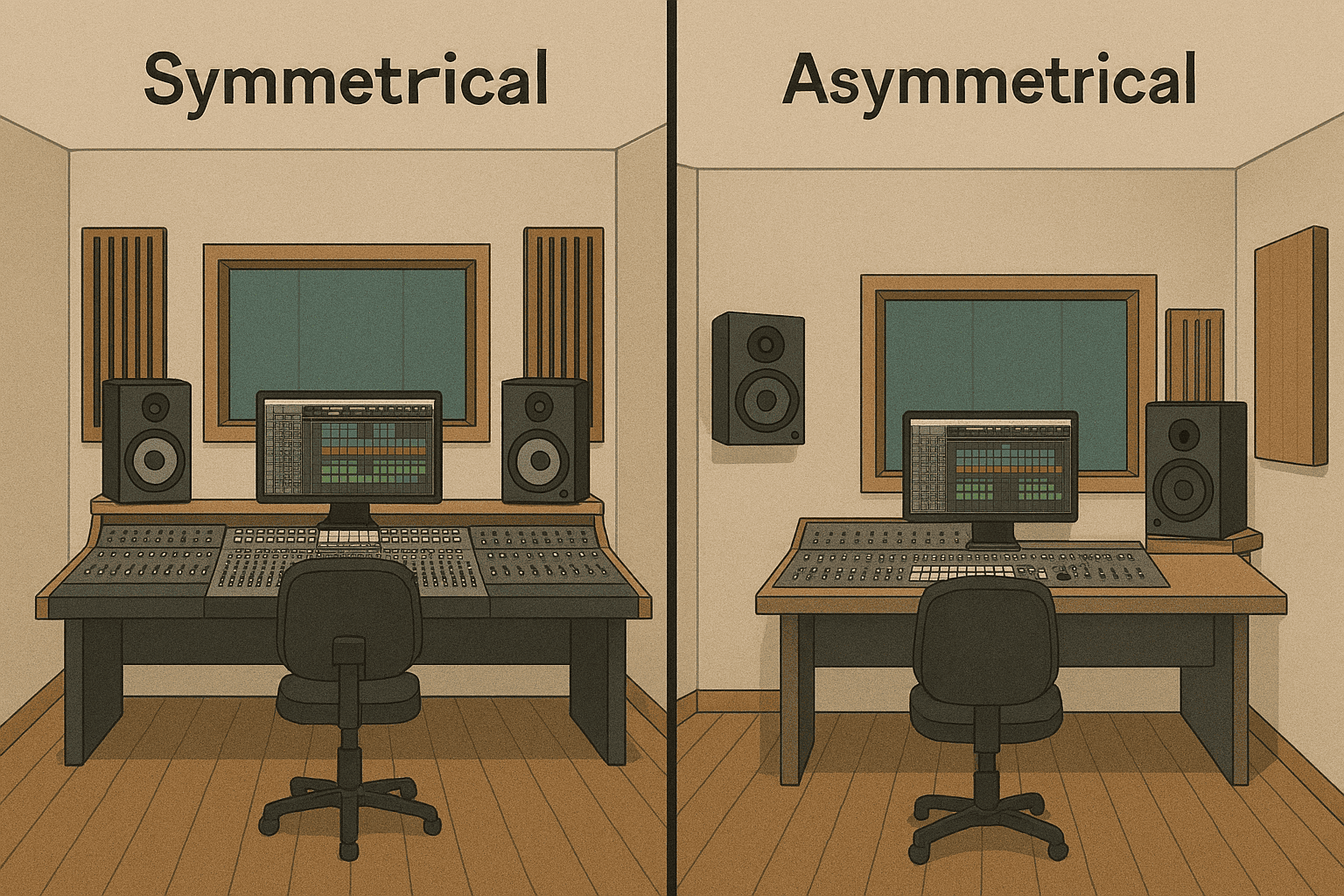
Symmetrical vs. asymmetrical room layouts is one of the most common points of confusion for people setting up a home studio.
Whether you are working with a converted bedroom, a basement corner, or a spare room with a window on one wall, the question of symmetrical vs asymmetrical layouts comes up almost immediately once you start thinking seriously about monitor placement.
Most acoustic treatment advice implicitly assumes a purpose-built rectangular room with a mix position centered between two side walls. In reality, most home studios are converted bedrooms, basements, garages, and spare rooms with windows on one wall, a closet on another, or furniture that simply can’t move. If your room doesn’t look like the textbook diagram, it’s worth understanding exactly what symmetry buys you.
Why Symmetry Matters for Stereo Imaging
Stereo mixing relies on your brain comparing subtle level and timing differences between your left and right ears. That comparison only works accurately if both sides of the room treat sound the same way. If one monitor is closer to a side wall than the other, the reflections reaching each ear are different in timing and frequency content — and your stereo placement judgment becomes unreliable without you noticing.
What Actually Needs to Be Symmetrical
True symmetry is only critical in a fairly narrow zone: the space immediately around your monitors and mix position, not the entire room. Specifically: equal distance from each monitor to the nearest side wall (the single highest-impact factor), equal distance from your listening position to each monitor, and similar reflective surfaces at each monitor’s first reflection point.
Everything outside that immediate zone — a closet on one back corner, a door on one side wall, an irregular ceiling shape — matters far less, because it’s not part of the direct early-reflection path shaping your stereo image at the mix position.
Common Asymmetrical Studio Problems and Fixes
Problem: Monitors off-center in the room. Prioritize your mix position and monitor placement over the room’s actual center. Center the listening triangle, not the furniture.
Problem: One side has a window, the other a solid wall. Add heavier curtains or a window-mounted acoustic panel to bring its reflective behavior closer to the solid wall side.
Problem: Sloped or irregular ceiling. Use the mirror trick to locate the actual ceiling reflection point given your specific slope, and treat that spot directly rather than assuming it’s centered overhead.
Problem: No room to move the desk to the center. Focus your treatment budget on matching first-reflection absorption on both sides rather than trying to physically relocate furniture. Equal treatment can meaningfully close the gap created by unequal room geometry.
When You Shouldn’t Worry About Symmetry
Not every asymmetry needs fixing: rear-of-room asymmetry has minimal impact on imaging at the mix position, front-wall décor differences beyond the immediate first-reflection zone rarely make an audible difference, and slight height differences in ceiling treatment outside the direct reflection points are a low priority.
The Bottom Line
You don’t need a purpose-built, perfectly rectangular room to mix accurately. You need a symmetrical relationship between your two monitors and your ears, and reasonably matched treatment at the points where sound reflects on its way to you. Everything else in the room is a secondary concern.