
MusicTech.blog
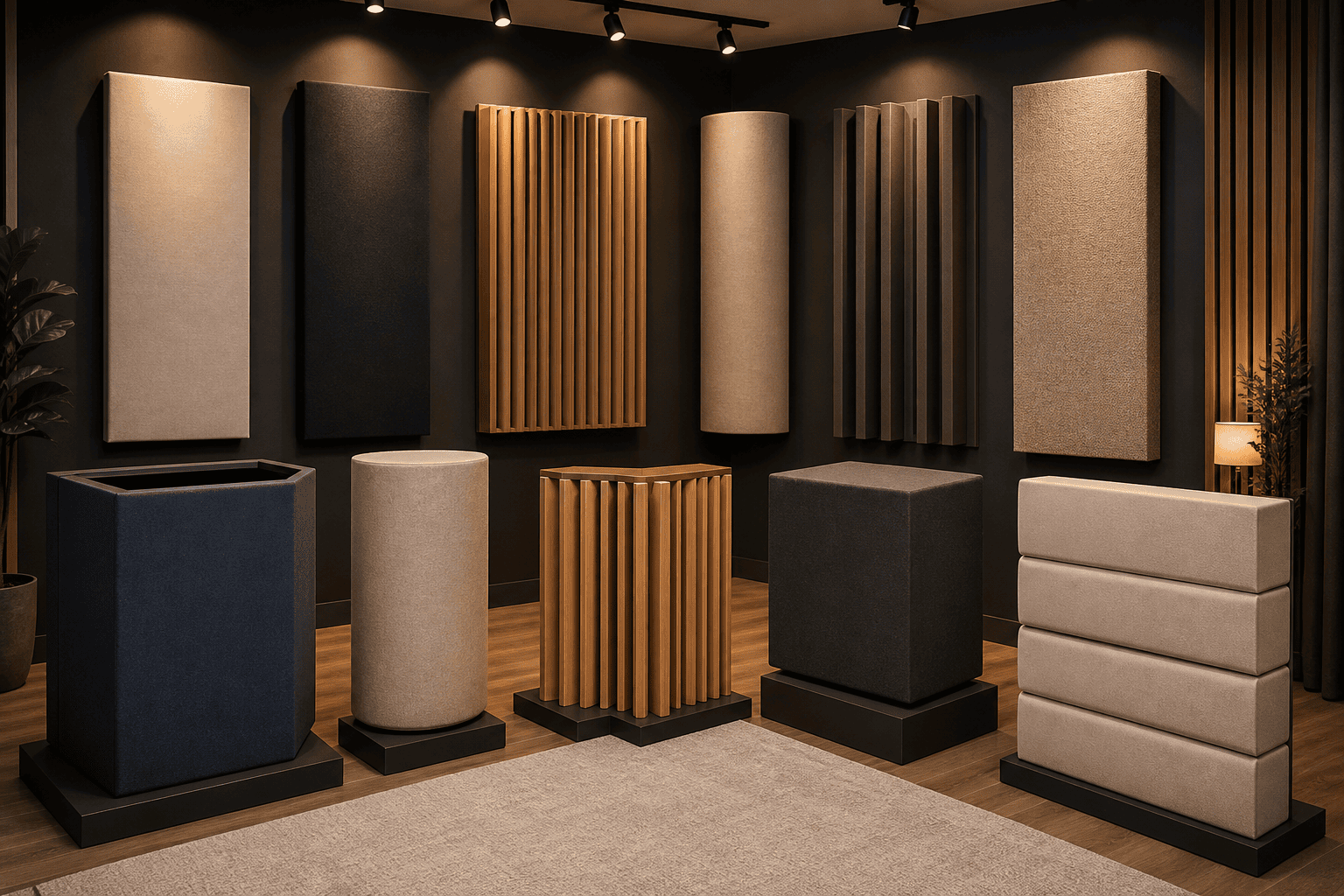
Bass traps get recommended constantly in home studio advice, often without much explanation of what they actually do.
If you’ve read anything about home studio acoustics, you’ve seen bass traps recommended before almost anything else. That advice can start to sound like a sales pitch, so it’s worth answering directly: what do bass traps actually do, and how do you know if your room needs them?
What a Bass Trap Actually Is
A bass trap is a thick, dense absorptive unit — usually rigid fibreglass, mineral wool, or a tuned resonant panel — built to absorb low-frequency energy that thinner acoustic panels can’t touch. Standard 2 to 4 inch foam panels are effective from the midrange up, but low frequencies have wavelengths measured in feet, not inches, and need much more depth and mass to be absorbed meaningfully.
Most bass traps are corner-mounted, floor-to-ceiling, because low frequencies build up most aggressively where two or three room boundaries meet.
Why Bass Builds Up in Corners
Low-frequency sound waves are omnidirectional and radiate outward in all directions, then reflect off every surface in the room. Because their wavelengths are so long, they build into standing waves that reinforce most strongly at room boundaries, and most strongly of all where multiple boundaries intersect. That’s why bass often sounds tighter in a room corner than in the center of the room.
This buildup is also frequency-dependent based on your room’s dimensions, which is why some rooms have a specific problem note — a particular bass frequency that always sounds too loud no matter what you play.
Signs Your Room Needs Bass Trapping
- Walk the room while a sustained bass note plays. If the volume swings dramatically as you move around, you’re hearing room mode buildup.
- Your mixes are consistently bass-heavy or bass-light compared to reference tracks, in a way that doesn’t correct itself.
- Low end sounds different at your mix position than a few feet to either side.
- You can hear a “one-note bass” problem — a specific note that jumps out disproportionately compared to notes around it.
Where to Put Them
Priority order for a typical rectangular home studio: the two front corners where the front wall meets the side walls (ideally floor-to-ceiling), the two rear corners for the same reason, and the wall-ceiling junctions for rooms with persistent modal problems. You don’t need to treat every corner to get a meaningful result — the front corners alone often account for most of the improvement.
DIY vs. Commercial Bass Traps
Commercial bass traps from brands like GIK Acoustics, Auralex, or Primacoustic are lab-tested and come pre-finished. DIY bass traps, typically built from rigid fibreglass insulation wrapped in acoustically transparent fabric, can match or exceed commercial performance at a meaningfully lower cost.
A cheaper but far less effective shortcut — stacking pillows or foam mattress toppers in corners — will do almost nothing for true low-frequency absorption.
What Bass Traps Won’t Fix
Bass trapping addresses low-frequency buildup, not every acoustic problem in a room. It won’t meaningfully reduce flutter echo, and it won’t correct a fundamentally asymmetrical room’s stereo imaging issues. Think of bass trapping as the foundation of a treatment plan, not the entire plan.
Bottom Line
If you’re mixing in a small or medium-sized untreated room, the odds are very high that bass trapping will produce an audible, immediate improvement. Start with the front corners, confirm the improvement with the walk-and-listen test, and expand from there.
Continue Reading in This Series
- Room Acoustics: Why Your Space Matters More Than Your Gear — the full treatment plan this guide fits into
- DIY Acoustic Panels: A Step-by-Step Build Guide
- Room EQ Wizard (REW) Setup Guide