
MusicTech.blog
Best Studio Monitors Under $500 in 2026: The Complete Guide
May 31, 2026
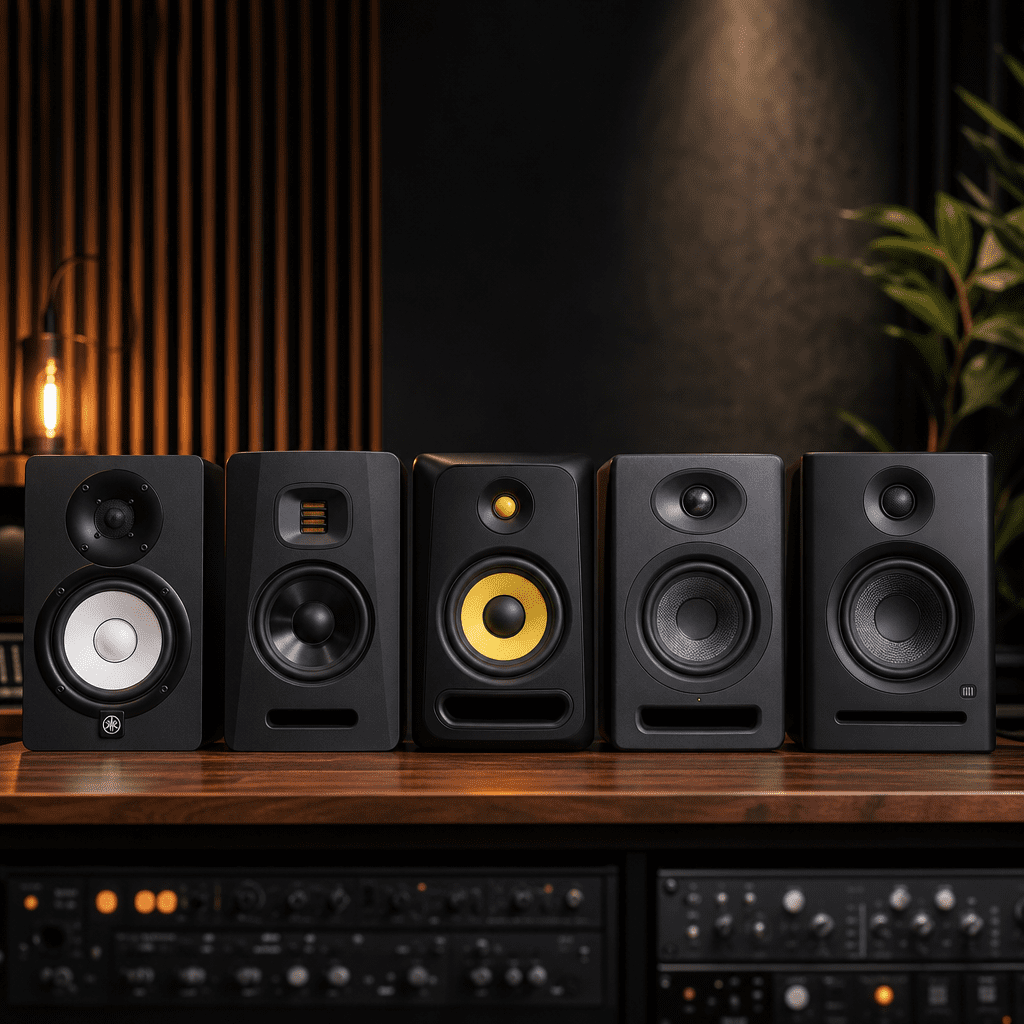
The $300–$500 price range is the sweet spot for home studio monitors — far enough up the ladder to deliver genuinely accurate, flat frequency response, but accessible enough that most serious home producers can reach it without breaking the budget. At this tier you’re looking at monitors that professional engineers wouldn’t be embarrassed to use for reference work. This guide covers the best options in 2026 across different room sizes, use cases, and sonic characters.
What to Look for in a Studio Monitor Under $500
Frequency response flatness is the primary criterion — you want a monitor that tells you the truth about your mix rather than flattering it. Look for a frequency response specification of ±3dB or better across the audible range. Bass extension matters for your room size: a 5-inch woofer extends to approximately 60–70Hz and suits rooms under 15 square metres; a 7-inch or 8-inch woofer extends lower and suits larger rooms, but can overwhelm small spaces with excessive bass buildup. Amplification power should be adequate for the room without constantly running near maximum volume, which increases distortion. And build quality matters — monitors are long-term studio investments, and cheap cabinets resonate and colour the sound.
Yamaha HS5 — The Transparent Reference Standard
The Yamaha HS5 is perhaps the most widely used studio monitor in its price class, found in home studios and professional reference setups worldwide. Its defining characteristic is an almost clinical transparency — it doesn’t flatter mixes, doesn’t add warmth, doesn’t make things sound exciting that aren’t. What it gives you is an accurate picture of exactly what’s in your mix, which is precisely what a reference monitor should do.
The HS5’s 5-inch woofer and 1-inch tweeter produce a frequency response that’s flat across the critical 80Hz–20kHz range, with usable extension down to approximately 54Hz. The white woofer cone is the HS series’ signature visual, but the real signature is the sound — dry, honest, and revealing of problems that more flattering monitors would paper over. Room control and high-trim response controls on the rear allow basic acoustic adjustment for placement near walls or in rooms with particular acoustic characteristics. At around $200 per speaker ($400/pair), it’s exceptional value at this price point.
Best for: Producers who prioritise mixing accuracy and translation above all else. If your mixes sound good on HS5s, they’ll sound good everywhere. Not recommended for producers who want an enjoyable listening experience — these are working tools, not hi-fi speakers.
Adam Audio T7V — The High-Frequency Detail Champion
The Adam Audio T7V uses Adam’s proprietary U-ART ribbon tweeter rather than a conventional dome tweeter — a design decision that produces measurably lower distortion and extends high-frequency response to 25kHz (significantly beyond the 20kHz limit of human hearing). The practical benefit is exceptional high-frequency detail and a smoother, less fatiguing treble compared to conventional dome tweeters. Extended sessions on Adam monitors tend to be less fatiguing than on monitors with aggressive high-frequency peaks.
The 7-inch woofer extends bass response down to 39Hz — genuine low-frequency extension that gives you a meaningful picture of what’s happening in your bass and kick drum, which 5-inch monitors can’t fully reproduce. DSP-controlled crossovers and EQ ensure accurate driver integration. At around $200 per speaker, the T7V competes directly with the HS5 at a very similar price point and is the better choice for producers who work with complex high-frequency content — bright synths, detailed cymbal work, or intricate reverb tails.
Best for: Electronic music producers, mix engineers who work with complex high-frequency content, and anyone whose previous monitors sounded harsh or fatiguing on extended sessions.
KRK ROKIT 5 G5 — The Studio Workhorse with Character
KRK ROKIT monitors have been a fixture in home studios and professional facilities since the 1990s. The G5 (5th Generation) ROKIT 5 continues the tradition with a voiced, slightly hyped low-mid response that makes them enjoyable to work on for long sessions — but this warmth comes at the cost of some transparency. Where the Yamaha HS5 tells you the cold truth, the KRK ROKIT 5 adds a hint of flattery.
The G5 addresses this with three voicing modes: Mix (flat response for critical mixing), Create (subtly sweetened for creative sessions), and Focus (enhanced midrange for detail work). This versatility makes the ROKIT G5 one of the most flexible monitors in the range. The built-in DSP and the companion KRK app provide 25-band EQ adjustment for room correction — a feature previously found only in more expensive monitors. At around $170 per speaker, it’s slightly cheaper than the HS5 and T7V while offering more features.
Best for: Producers who work in untreated rooms and need DSP room correction, those who do long creative sessions and value a more musical (if slightly less clinical) sound, and anyone who wants flexibility between mixing and creative modes.
Focal Alpha 50 Evo — The Professional Upgrade
Focal’s Alpha Evo series sits at the top of the sub-$500 range and reflects Focal’s heritage as a manufacturer of high-end professional monitoring equipment. The Alpha 50 Evo’s 5-inch woofer and 1-inch tweeter are built with the same attention to driver quality that defines Focal’s professional studio monitors — the kind found in major recording studios. The result is a level of resolution and imaging that clearly distinguishes itself from the monitors above.
Stereo imaging — the ability to precisely locate sounds within the stereo field — is where the Alpha 50 Evo particularly excels. Panning decisions made on these monitors translate with greater accuracy than on monitors with less precise imaging. The cabinet is built with a minimal diffraction design that reduces colouration from the cabinet itself. At around $400 per speaker ($800/pair), it sits above our $500/pair threshold for the full pair but within budget if purchasing a single monitor or finding a deal — and worth the stretch for serious mixing work.
Best for: Engineers who do serious mixing and mastering work at home and want professional-grade imaging and resolution without moving to the four-figure monitor tier.
PreSonus Eris E5 XT — Best Value Option
The PreSonus Eris E5 XT is the most affordable recommendation on this list at around $100 per speaker, and it punches well above its weight. The 5.25-inch Kevlar low-frequency transducer and 1-inch silk dome tweeter produce a frequency response that’s more accurate than its price suggests. Acoustic tuning controls — high-pass filter, mid-frequency control, and high-frequency control — allow meaningful adjustment for different room placements and acoustic characteristics.
The E5 XT is not as transparent or resolving as the monitors above it, and its bass extension is more limited. But for beginners building their first studio setup or producers on a tight budget who want a genuine step up from consumer speakers, the Eris E5 XT represents outstanding value. Deep integration with Studio One (PreSonus’s DAW) is a bonus for Studio One users, though it works perfectly with any DAW.
Best for: Beginners, producers on a tight budget, secondary desktop reference monitors for checking translations.
Which Monitor Should You Buy?
- Best for accuracy and translation: Yamaha HS5 — the honest reference standard
- Best for high-frequency detail and long sessions: Adam Audio T7V — ribbon tweeter advantage
- Best for flexibility and untreated rooms: KRK ROKIT 5 G5 — DSP room correction and voicing modes
- Best for serious mixing resolution: Focal Alpha 50 Evo — professional heritage, premium imaging
- Best budget option: PreSonus Eris E5 XT — genuine accuracy at a low entry price
Whatever you choose, the room you put them in matters as much as the monitors themselves. A HS5 in a well-treated room will tell you more truth than a Focal Alpha in an untreated bedroom. Acoustic treatment — even basic corner bass traps and first-reflection absorption — is always money better spent than upgrading monitors before addressing the room.