
MusicTech.blog
Universal Audio Apollo Twin X Review: Professional Quality at Home Studio Price?
July 20, 2026
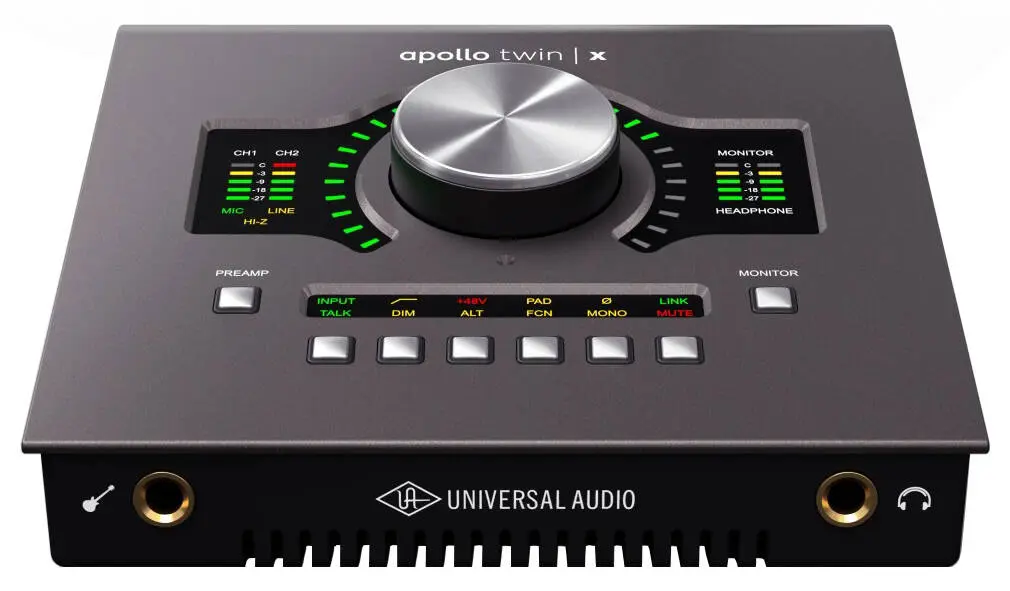
The Universal Audio Apollo Twin X is the most aspirational audio interface in the home studio market — priced significantly above the competition, bundled with UA’s LUNA recording software and a collection of UAD plugin licenses, and offering something that no other interface in its price range provides: the ability to run DSP-powered UAD plugins in real time with near-zero latency during recording, including UA’s critically acclaimed hardware emulations. This review examines whether the Apollo Twin X delivers enough real-world advantage to justify its price premium.
What Makes the Apollo Different
Every other audio interface in the home studio market captures your signal, converts it to digital, and sends it to your computer’s CPU for processing by your DAW and its plugins. The Apollo Twin X has a dedicated SHARC DSP processor built in — a separate chip that runs Universal Audio’s proprietary UAD plugin format independently of your computer’s CPU. This means you can run UAD emulations of classic hardware during tracking — an LA-2A on the vocal, a 1176 on the guitar, a Neve 1073 preamp emulation on the input — at near-zero latency, without using any CPU resources from your computer.
The practical value: recording through a hardware-quality compressor emulation in real time, hearing exactly what the processed signal sounds like as you perform, without the latency that typically makes real-time plugin monitoring impractical at low buffer sizes.
Preamp Quality
The Apollo Twin X’s UNISON preamps are genuinely among the best available in a desktop interface. UNISON technology allows the preamp’s impedance, gain, and character to change based on which hardware emulation is loaded — running the UA 610-B tube preamp emulation, for example, changes the hardware impedance to match the real 610-B. This interaction between the software model and the hardware preamp is what makes the emulations sound more convincing than simple plugin processing after the fact.
Measured performance is excellent: low noise floor, high dynamic range, and a clean character in bypass that doesn’t impose unwanted colouration on the signal before the emulation is applied.
The UAD Ecosystem: Value and Lock-in
The Apollo comes bundled with a selection of UAD plugins — typically a Neve 1073 preamp emulation, an LA-2A, and several others depending on the bundle purchased. The UAD plugin library is the most comprehensive collection of high-end hardware emulations available, including emulations of classic compressors, equalizers, tape machines, and reverbs that are widely considered among the best software reproductions of their hardware originals.
The limitation: UAD plugins only run on UA hardware. They don’t work on any other computer without a UAD interface or Satellite DSP accelerator connected. This is both the ecosystem’s strength (UA has a significant investment incentive to maintain and improve its plugin library) and its primary limitation (your UA plugin purchases are tied to UA hardware in perpetuity).
Is It Worth the Premium?
The Apollo Twin X costs approximately 3–4 times the price of a Focusrite Scarlett 2i2 or SSL 2+. The question of whether it’s worth this premium depends entirely on how you work. If you record performances that benefit from hearing a professional compressor or preamp emulation in real time — vocals, live instruments, any tracked performance where the monitoring sound affects the performance — the Apollo’s low-latency DSP monitoring has genuine practical value that no other desktop interface provides. If you primarily produce in-the-box with virtual instruments and rarely record live sources, the premium is harder to justify.
For the home studio producer who takes recording seriously and wants the closest thing to a professional studio’s hardware monitoring chain in a desktop device, the Apollo Twin X is the correct choice. For the producer who primarily writes and produces with virtual instruments, a Focusrite Scarlett 4i4 or SSL 2+ at one-third the price delivers everything that matters.