
MusicTech.blog
Classic Synthesizers: A History of Iconic Instruments
August 19, 2025
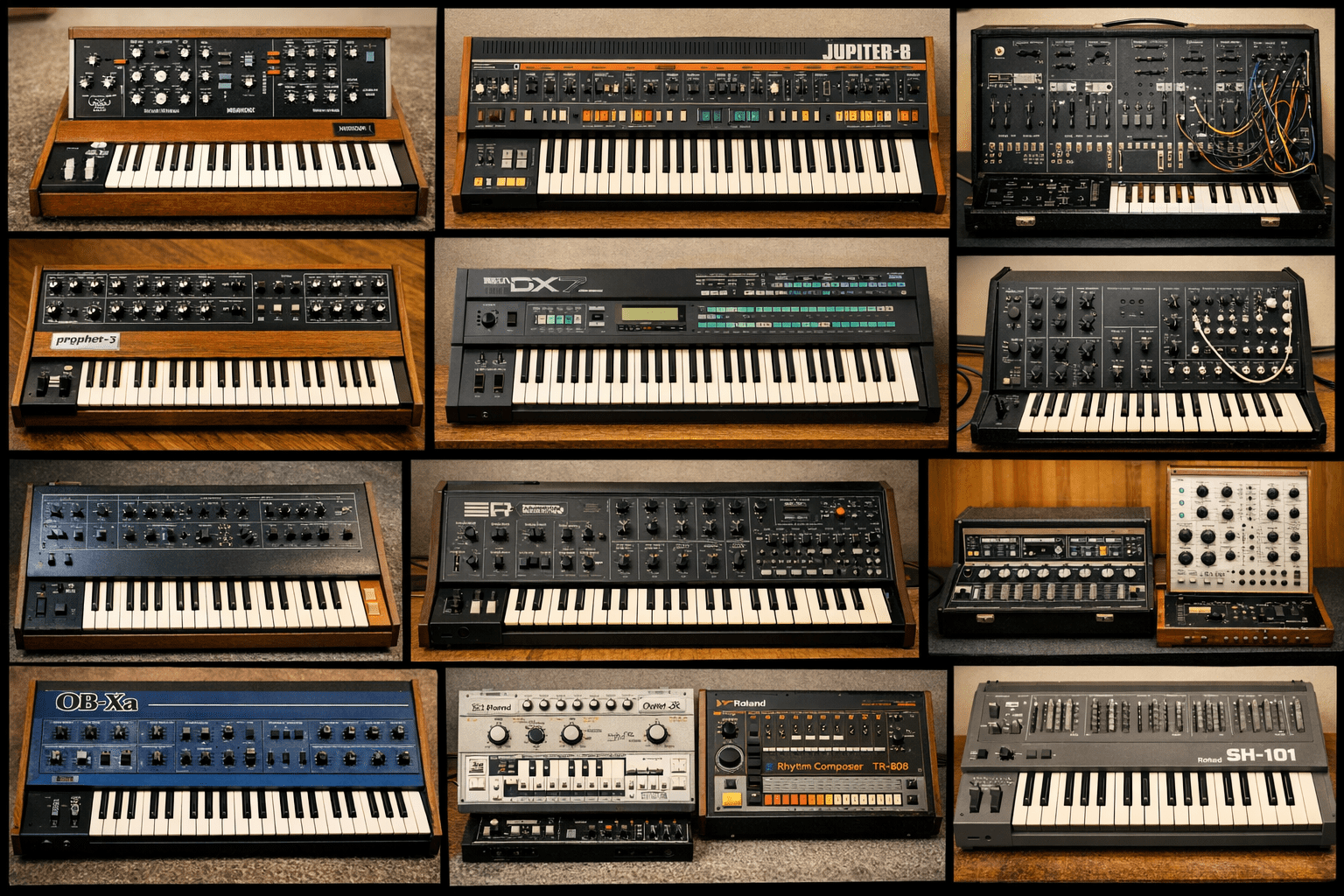
No instrument category has shaped modern music more comprehensively than the synthesizer. In six decades it has gone from a room-sized academic curiosity to a pocket-sized professional tool, from a novel special effect to the dominant sound of popular music, from analog voltage-controlled circuits to digital algorithms that simulate physics and acoustics with extraordinary fidelity. The history of the synthesizer is inseparable from the history of electronic music — and much of the history of music in general.
This is part of our Synthesizers Explained guide.
Before the Synthesizer: Electronic Instruments, 1900–1960
Electronic sound generation predates the synthesizer by decades. The Telharmonium (1906) used rotating electrical generators to produce tones distributed over telephone lines — the first electronic instrument of significant scale, and also the first commercial failure of the electronic music era. The Theremin (1928) — created by Russian physicist Léon Theremin — was the first instrument controlled without physical contact, using hand proximity to two antennas to control pitch and volume. Clara Rockmore’s mastery of the Theremin remains the definitive demonstration of its expressive possibilities.
The history of the synthesizer from the Theremin and Moog to the DX7, TB-303, and modern Eurorack modular — and the instruments that shaped modern music.
The Hammond Organ (1935) was not conceived as a synthesis instrument but became one of the most widely used. Its nine-drawbar system of harmonic partials is additive synthesis in practice; its Leslie rotary speaker cabinet adds amplitude and pitch modulation that became inseparable from its sound. The Hammond B-3 and C-3 models define a tone heard in gospel, soul, jazz, and rock that remains immediately recognisable.
The Moog Synthesizer and the Modular Era, 1960s
The modern synthesizer era begins in 1964 with Robert Moog‘s first voltage-controlled synthesizer modules, developed in collaboration with composer Herbert Deutsch. Moog’s critical innovation was the use of standardized voltage control: a 1-volt-per-octave pitch standard and a common control voltage format that allowed different modules — oscillators, filters, amplifiers, envelope generators — to interconnect and communicate. This created a modular architecture that could be expanded and reconfigured, rather than a fixed-function instrument.
Simultaneously on the West Coast, Don Buchla was developing his own modular system with a fundamentally different philosophy. Where Moog’s design was keyboard-centric and melody-focused, Buchla’s system used touch-sensitive panels, random voltage sources, and sequencers — prioritising abstract, non-traditional performance approaches. The Moog/Buchla dichotomy established what is still called the “East Coast” (keyboard-based, note-oriented) and “West Coast” (timbre-focused, non-derstand how synthesizers are controlled — MIDI messages and CC numbers, CV/gate in analog and modular sykeyboard) schools of synthesis philosophy.
Wendy Carlos’s Switched-On Bach (1968) — a complete recording of Bach’s music performed on the Moog — demonstrated to the world that the synthesizer was a serious musical instrument. It sold over a million copies and won three Grammy Awards, introducing the synthesizer to mainstream popular consciousness.
The Minimoog and Portable Synthesis, 1970
The Minimoog’s three-oscillator design, its ladder filter (the definitive resonant low-pass filter, characterized by its smooth rolloff and musical self-oscillation), and its portamento (glide) capability defined the sound of progressive rock bass lines and leads, funk synthesizers, and jazz fusion. Keith Emerson, Rick Wakeman, Jan Hammer, and Sun Ra all used it as a primary instrument.
Polyphony Arrives: ARP, Oberheim, Sequential Circuits, 1970s
The Minimoog was monophonic — one note at a time. The 1970s pursuit of polyphony produced several landmark instruments. ARP Instruments produced the ARP 2600 (a semi-modular system popular in film scoring and by Pete Townshend and Joe Zawinul), the ARP Odyssey (a dual-oscillator analog synth with distinctive patching options), and the ARP String Ensemble (an early polyphonic synthesizer using divide-down technology).
The Sequential Circuits Prophet-5 (1978) was a turning point: the first synthesizer with fully programmable, storable patches. Five voices, each with two oscillators, a Curtis filter, and ADSR envelopes — all settings saveable to 120 memory locations. The Prophet-5’s ability to recall patches made it viable for live performance and studio work in a way that previous analog instruments were not. Its warm, creamy sound — particularly in pad and brass sounds — is one of the most beloved timbres in the history of recorded music.
The Digital Revolution: DX7 and the 1980s
The early 1980s were defined by the transition from analog to digital synthesis. The Yamaha DX7 (1983) was the catalyst. Its six-operator FM synthesis produced sounds that analog instruments couldn’t — the electric piano patch (preset 11B) alone appeared on thousands of recordings. At under $2,000 it was dramatically less expensive than comparable analog polysynths, and it sold over 200,000 units.
The DX7’s success drove many analog synthesizer manufacturers out of business — Moog, ARP, and Sequential Circuits all struggled or failed in this period. Roland, however, responded with complementary digital approaches. The Roland D-50 (1987) introduced Linear Arithmetic synthesis — a hybrid of short PCM sample attacks (“upper partials”) with digitally synthesised sustains, plus onboard effects including reverb. The D-50’s lush, atmospheric presets (“Digital Native Dance,” “Fantasia,” “Intruder”) defined a late-1980s cinematic and new age sound.
The Korg M1 (1988) pioneered the workstation format — a synthesizer, sequencer, effects processor, and drum machine in a single instrument. Its PCM-based synthesis and powerful factory sounds made it the best-selling synthesizer of all time, with over 250,000 units sold.
The Roland TB-303 and the Accidental Genre
The Roland TB-303 Bass Line (1981) was a commercial failure. Intended as an automatic bass accompaniment unit for guitarists practising alone, it was notoriously difficult to program and sounded nothing like a real bass guitar. It was discontinued after two years and flooded the secondhand market at low prices.
In the mid-1980s, Chicago DJ and producer Larry Heard (along with others in the emerging house music scene) discovered that the TB-303 tuned to extreme settings — filter cutoff fully open with high resonance sweeping in real time — produced an entirely new kind of sound: squelchy, rubbery, alien. This sound became acid house and, shortly after, the foundation of a global genre. The TB-303 is one of the most striking examples in musical history of an instrument finding its purpose long after its intended use was abandoned.
Virtual Analog and the 1990s–2000s
As personal computing became powerful enough to run real-time synthesis, software synthesizers emerged as a credible alternative to hardware. But before that, hardware virtual analog synthesizers attempted to combine the warmth and character of analog synthesis with the stability and programmability of digital technology.
The Access Virus (1997) became the dominant VA synthesizer for electronic music production — its dense, fat sound and extensive modulation capabilities made it particularly popular in trance, techno, and house production. The Nord Lead (1995) was simpler and more performance-oriented, with four-part multi-timbrality and a clean, direct interface that made it beloved by keyboardists. The Clavia Nord Lead 2 remained in production and professional use for over two decades.
Software synthesis arrived seriously with Native Instruments Pro-52 (1999, modeling the Prophet-5) and NI FM7 (2001, modeling the DX7), followed rapidly by a proliferation of soft synths that made every synthesis type available as a DAW plugin.
The Modular Revival and the Modern Era
The 2010s saw an extraordinary revival of modular synthesis, driven by the Eurorack format established by Doepfer in the mid-1990s. Eurorack standardizes module size (height measured in U, width in HP), power supply voltage, and audio/CV signal levels, allowing modules from hundreds of different manufacturers to interconnect freely. The modular revival has produced a thriving ecosystem of innovative synthesis modules covering every conceivable approach — wavefolder circuits, spectral processors, computer-music interfaces, and implementations of historical synthesis techniques that were never previously available as hardware.
Simultaneously, software synthesis reached new peaks of quality and accessibility. U-He Diva’s component-level analog modeling, Xfer Serum’s wavetable precision, and the free Vital and Surge XT instruments represent the current state of the art — tools that outperform hardware of comparable cost in almost every technical respect, while the hardware world produces instruments like the Moog One, the Sequential Prophet-6, and the Arturia PolyBrute that find new expressive possibilities in revisited analog architecture.
Quick Reference: Landmark Synthesizers
- Moog Minimoog Model D (1970) — portable analog synthesis; the definitive monophonic synth
- ARP 2600 (1971) — semi-modular; film scoring, prog rock, R2-D2
- Oberheim OB-X (1979) — polyphonic analog; arena rock and pop pads
- Sequential Circuits Prophet-5 (1978) — first fully programmable polysynth
- Roland TB-303 (1981) — failed bass machine; accidentally invented acid house
- PPG Wave 2.2 (1981) — first wavetable synthesizer
- Yamaha DX7 (1983) — FM synthesis; best-selling professional synth of its era
- Roland D-50 (1987) — Linear Arithmetic; late 1980s cinematic pads
- Korg M1 (1988) — workstation; best-selling synthesizer of all time
- Yamaha VL1 (1994) — first physical modeling synthesizer
- Nord Lead (1995) — virtual analog; performance and studio classic
- Access Virus (1997) — virtual analog; electronic music production standard
- Korg Wavestation (1990) — wave sequencing; evolved from the PPG concept
Quick Tips to Carry Forward
- Knowing why an instrument was designed the way it was explains its strengths and weaknesses better than any parameter description
- Many classic synthesizers are available as free or affordable software emulations — Dexed (DX7), u-he Repro-1 (TB-303), Arturia V Collection (many classics)
- The Moog/Buchla split (East Coast vs. West Coast synthesis philosophy) still shapes how modern instruments are designed
- “Virtual analog” hardware was a transitional technology — high-quality VA soft synths now surpass it
- Eurorack modular allows you to build a bespoke synthesis system from individual modules — powerful but expensive and complex
The history of the synthesizer is a history of accidents, commercial pressures, technological constraints, and creative responses to those constraints. The TB-303’s failure produced acid house. The DX7’s difficult interface produced a generation of programmers who became professional sound designers. Understanding this history makes the instruments themselves more legible — and more inspiring.
Related: Subtractive Synthesis Explained • Physical Modeling Synthesis Explained • Synthesizers Explained (complete guide)
The Synthesizer Museum maintains an extensive archive of classic instrument specifications and history at Vintage Synth Explorer.
Further Reading
- Synthesizers Explained: Types of Synthesis, History, and How Synths Work
- Subtractive Synthesis Explained: Oscillators, Filters, and Envelopes
- FM Synthesis Explained: Operators, Algorithms, and the Yamaha DX7
- Wavetable Synthesis Explained
- Synthesizer Control Explained: MIDI, CV/Gate, MPE, and Expression